Scripture beside the commentaries, confessions, and reference works of the Reformed church. It runs on your own Windows machine, it works with the network off, and it is free.
What it is
Scripture, and the Church Reading It With You
Sojourner is a free, offline Windows desktop application for reading the Bible beside the
commentaries, confessions, and reference works the Reformed church has been handing down for
four hundred years. The Hebrew and Greek lie underneath, and the tools for preparing a sermon
and leading family worship sit on top. All of it is on your own machine. None of it asks you to sign in.
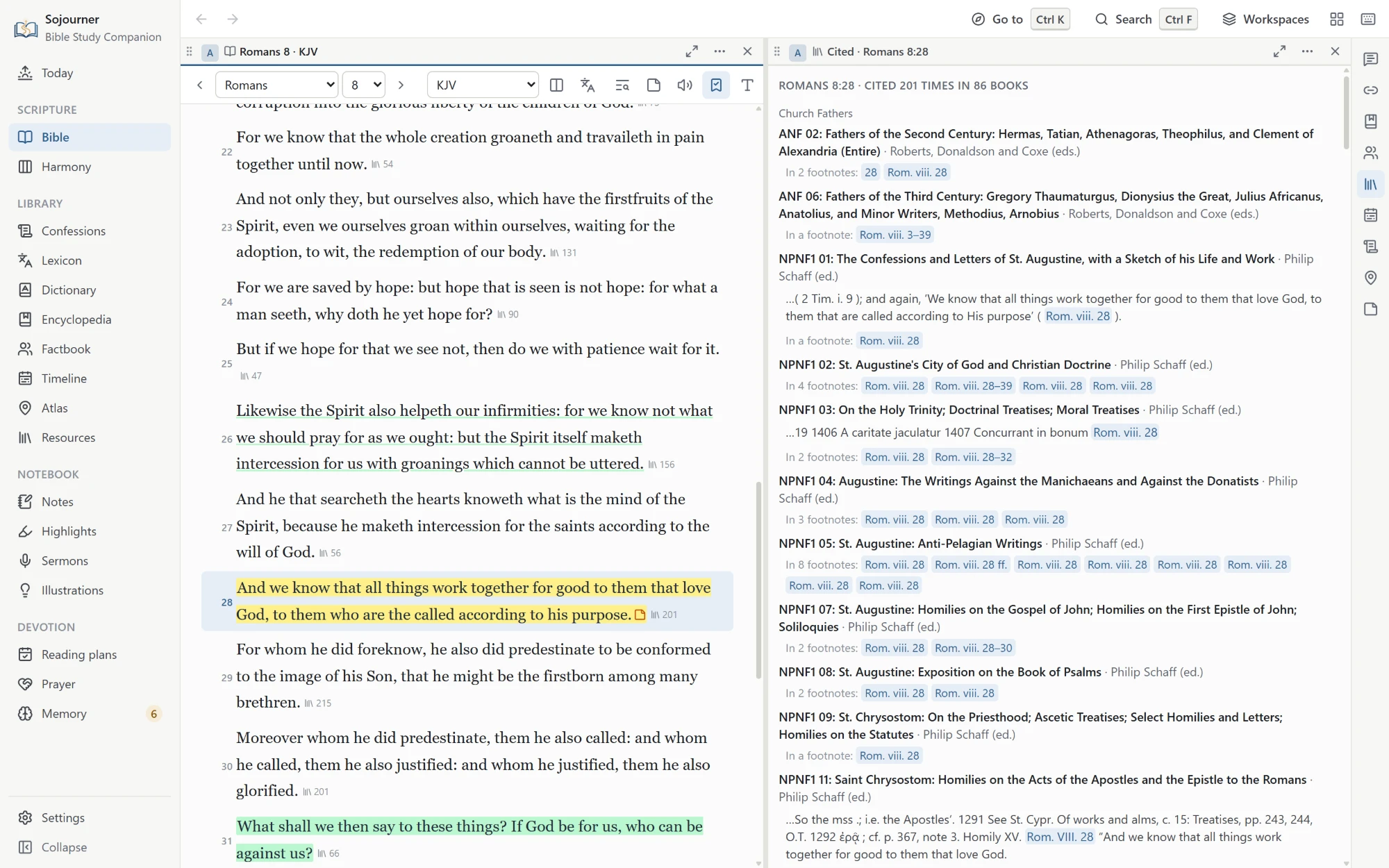
Romans 8:28 with Matthew Henry’s Commentary on the Whole Bible beside it and the cross references below. The small number after each verse counts the times your books cite it.
Most study software wants something from you first. An account. A subscription. A connection.
A tier that hides the good commentaries until you pay. Sojourner wants none of it. You install
it, and the Bibles, the commentaries, and the reference works are already there.
The word sojourner is what the saints called themselves while they were still walking. You are
passing through, and you need the road marked. That is the whole idea behind it.
It opens with one of eleven verses about the Word of God. Here it is Psalm 119:19. I am a stranger in the earth.
It is a servant, not a substitute. A program cannot preach to you, baptize you, or feed you at
the Lord’s Table. Use it through the week, and be under the Word in your own church on the
Lord’s Day.
Download
Get Sojourner
Sojourner 0.3.4
Free · Windows 10 and 11, 64-bit · About 584 MB
One installer with everything but the book library inside it. No account to make and
nothing to buy. The books come as four shelves, each its own download. They are on the releases page too,
further down, under Sojourner Library Pack.
The installer bundles the Microsoft Edge WebView2 runtime that Sojourner draws with, so it
installs on a machine that has never been online.
If you already have an earlier version, run the new installer over the old one. Your notes,
highlights, sermons, prayers, bookmarks, and installed shelves are all kept. Even so, make a
backup first. You will find it in Settings, under Data and backups.
This version was made from readers’ letters. Read-aloud now starts where you are and no
longer fails on a long book. The Psalter has a page of its own, the timeline carries the
history of the church, every Greek and Hebrew word shows its grammar in plain English, and
Webster’s dictionary of 1828 gives the older senses of the King James words. Popups stay
on the screen now, and a handful of faults are fixed.
The book shelves have not changed, so the ones you have work with this version as they are.
The one exception is a Sojourner Library shelf downloaded before September 25. The copy there
now has one more book, so download it again if you want it, then open Settings, choose Book
library, and pick Install or update a shelf.
New to the program? A tutorial built into it walks through every feature. You will find it in
Settings, under Tutorial.
Two Honest Warnings
Neither of these is a problem with the program, but you should know about both before you
double-click anything.
Windows will warn you. The installer is not code-signed, because a
certificate costs money this work does not have. So SmartScreen shows a blue box the first
time you run it. Click More info, then Run anyway. The
release page lists the installer’s SHA-256 checksum, a kind of fingerprint for the file,
so anyone who knows how can confirm the file is the one that was published. The installer is
built by GitHub from the public source code, not on anyone’s own computer, and the
release page links the record of that build. If the warning
makes you uneasy, that instinct is a good one, and you are welcome to pass on it.
It is a large download. About 584 MB, because the texts and the reading voice
are all inside it rather than fetched from a server later. That is the trade. One long
download once, and then the program never needs the network again.
Version 0.3.4 means what it says. This is early, real, and in use, but it is not finished.
Things will change and some of them will break. If something goes wrong, tell me and I will
fix it.
What is inside
The Library It Ships With
All of this installs with the program. Nothing is held back, nothing unlocks later, and none
of it needs a connection to open.
Thirteen translations
Public domain or free to share
The eight older ones are the King James of 1769, the American Standard of 1901,
Young’s Literal, Darby, Webster’s, the Geneva of 1599, Douay-Rheims, and
Tyndale, which has the New Testament, the five books of Moses, and Jonah. The five modern
ones are free because their makers let them be shared. They are the
World English Bible, the Berean Standard Bible, the Literal Standard Version, and
unfoldingWord’s Literal and Simplified Texts.
The original texts
Hebrew, Greek, and Latin
The Hebrew Old Testament from the Leningrad Codex, the oldest complete copy of the Hebrew
Bible, read right to left. Five editions of the Greek New Testament. The Textus Receptus is
the Greek text behind the King James. The Byzantine text follows the great number of later
copies, and the Westcott and Hort, Tregelles, and SBL editions weigh the oldest copies most
heavily. Also the Septuagint, the ancient Greek translation of the Old Testament, and the
Latin Vulgate in its Clementine edition. All of them follow English chapter and verse
numbering, so they line up with the English beside them.
The lexicons
For readers with no Greek or Hebrew, and for those with some
A lexicon is a dictionary of the Hebrew or Greek words. Strong’s and Thayer’s
are the ones most readers start with. The full Brown, Driver, and Briggs is here for Hebrew,
with Abbott-Smith and Liddell, Scott, and Jones for Greek, and STEPBible’s brief
lexicons for both. Double-click any word in the text for its entry. There is
more on this below.
Commentaries
Henry, Calvin, Jamieson, Barnes, Spurgeon
The six volumes of Matthew Henry’s Commentary on the Whole Bible, the forty-five
volumes of Calvin, Jamieson, Fausset and Brown, Barnes’ Notes on the New
Testament, and Spurgeon’s Treasury of David on all one hundred and fifty Psalms. The
footnotes Calvin’s translators added are marked as theirs and kept apart from his own
words.
The Westminster Standards
With proofs and a topic index
The Confession, the Larger Catechism, and the Shorter Catechism, each with its Scripture
proofs and a doctrinal index. Hodge and Shaw on the Confession and Vincent on the Shorter
Catechism sit right beside them. For the household there are also the Catechism for Young
Children of 1840, written to lead a child on to the Shorter, and the Church of
Scotland’s Directory for Family-Worship of 1647.
The wider confessions
The creeds and the Three Forms of Unity
The Apostles’, Nicene, Athanasian, and Chalcedonian creeds, the Belgic Confession,
the Heidelberg Catechism, and the Canons of Dort with their Rejection of Errors, all in old
public domain translations.
The Psalter
1650, with tunes you can play
The 1650 Scottish Metrical Psalter in full, all one hundred and sixty-three settings, on a
page of its own. Thirty-nine tunes play in the program, so you can hear the line before you
sing it.
Read aloud
A voice that runs on your machine
A neural voice ships with the program and reads any chapter, commentary, or book aloud with
no connection. It starts at the page you are on, or at any passage you select, and a list in
the player jumps ahead. Words light up as it reads, there is a sleep timer, and you can
correct how it says a name. A reference like John viii. 23 is read as John 8, verse 23.
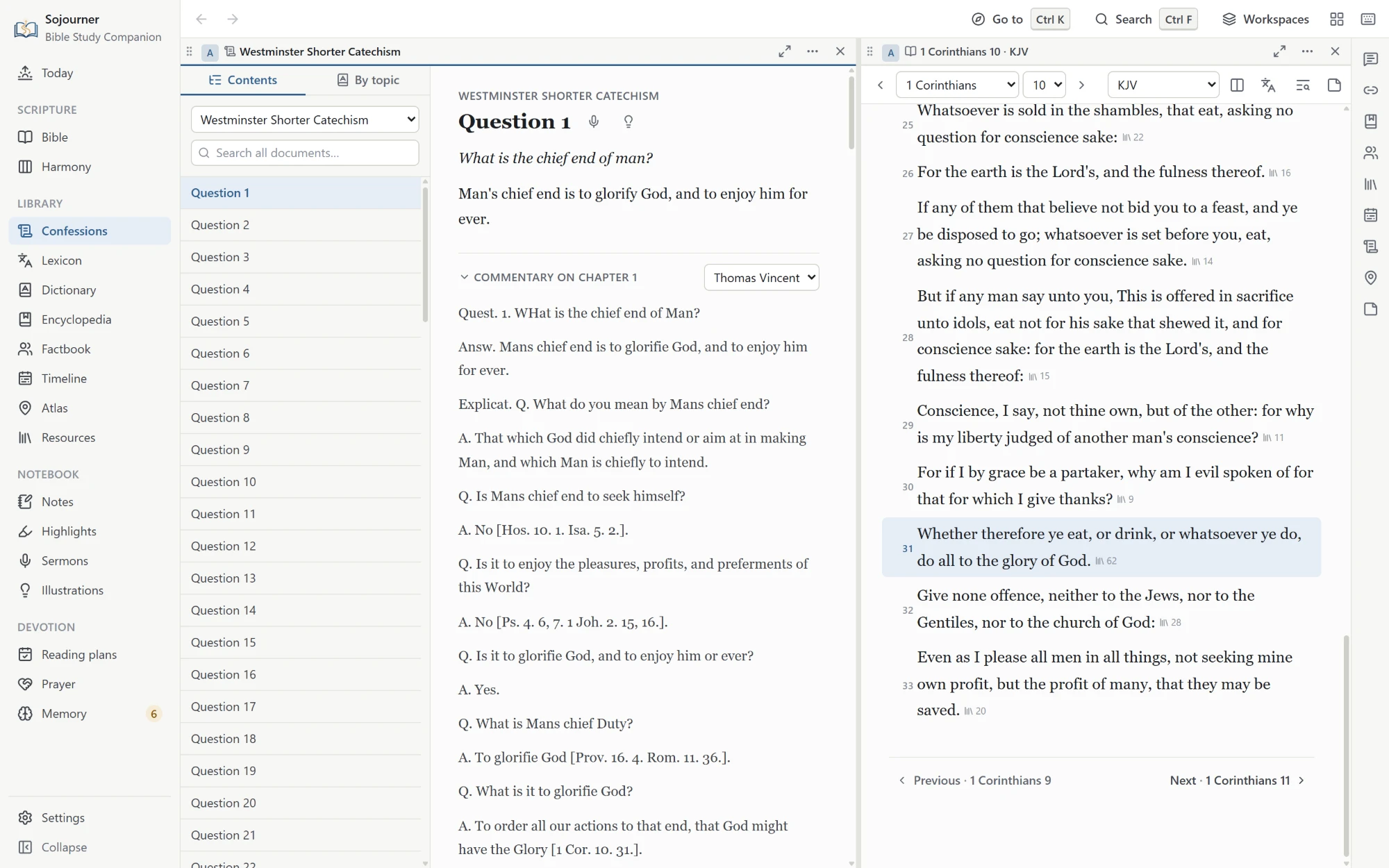
The Shorter Catechism’s first question, with Thomas Vincent opening it up and 1 Corinthians 10:31, one of its proof texts, open beside it.
Reference
How Much Is in There
These are counts of very different things, so read them one at a time rather than against
each other.
9,349Encyclopedia articles, the International Standard Bible Encyclopedia of 1915
69,580Entries in Noah Webster’s American Dictionary of the English Language of 1828
5,998Dictionary entries, Easton’s and Smith’s merged by headword
344,757Cross references
4,275People, places, and things in the Factbook, each with its own page
1,342Atlas places, each with coordinates and every verse that names it
464Events on the timeline, from the Creation to Paul in Rome
296Events of church history, from the apostles to the present, each dated by its source
271Puritan and Reformed works on the Sojourner Library shelf
38Volumes of the Church Fathers on a shelf of their own
39Tunes for the 1650 Scottish Metrical Psalter, playable
14Atlas journeys, from Abraham to Paul’s voyage to Rome
6Reading plans, including M’Cheyne, a chronological year, and four weeks of family worship
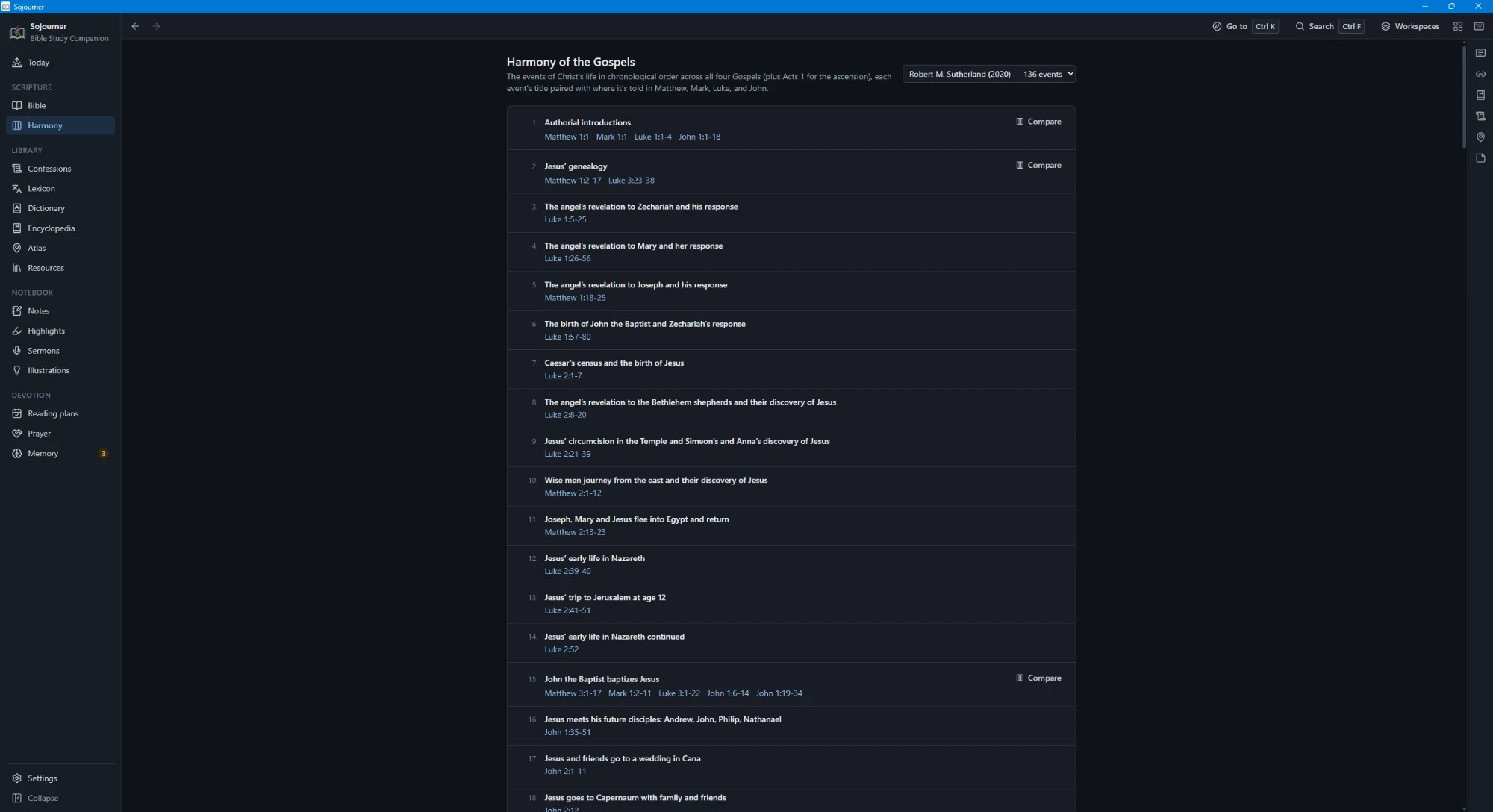
2Harmonies of the Gospels in four columns, Sutherland’s of 2020 and Robertson’s of 1922
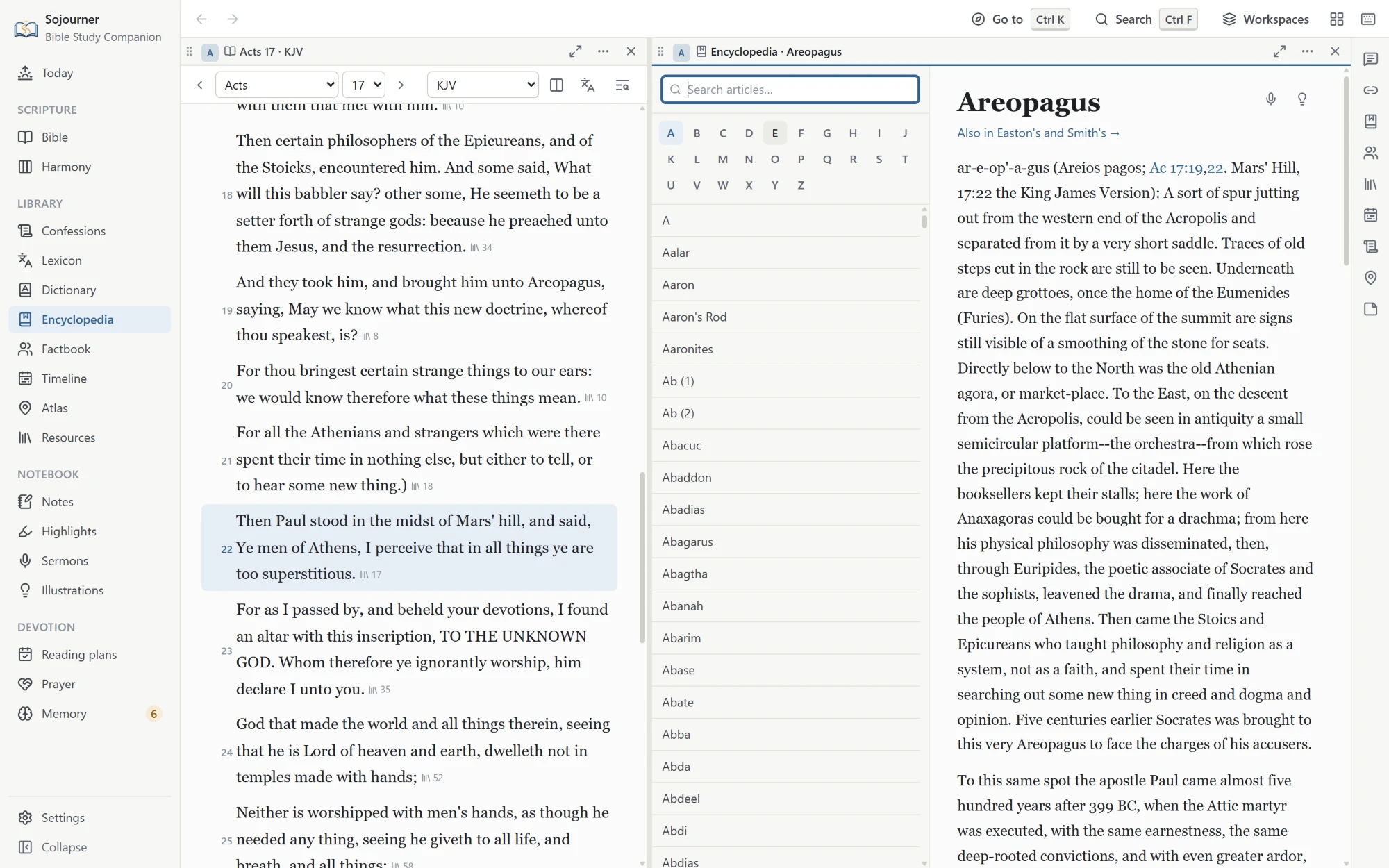
Acts 17 beside the encyclopedia’s article on the Areopagus, the hill where Paul preached in Athens.
Webster’s 1828
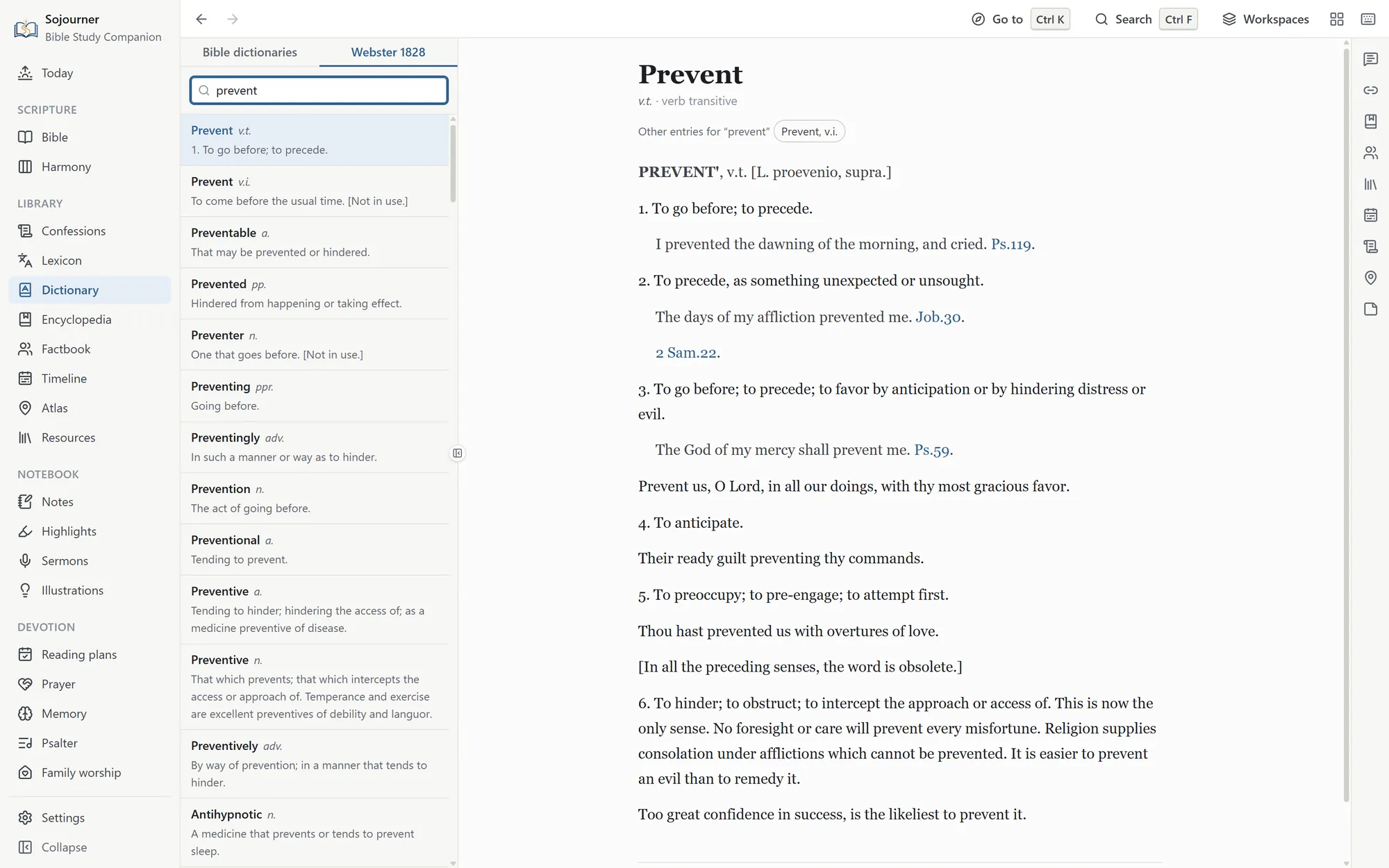
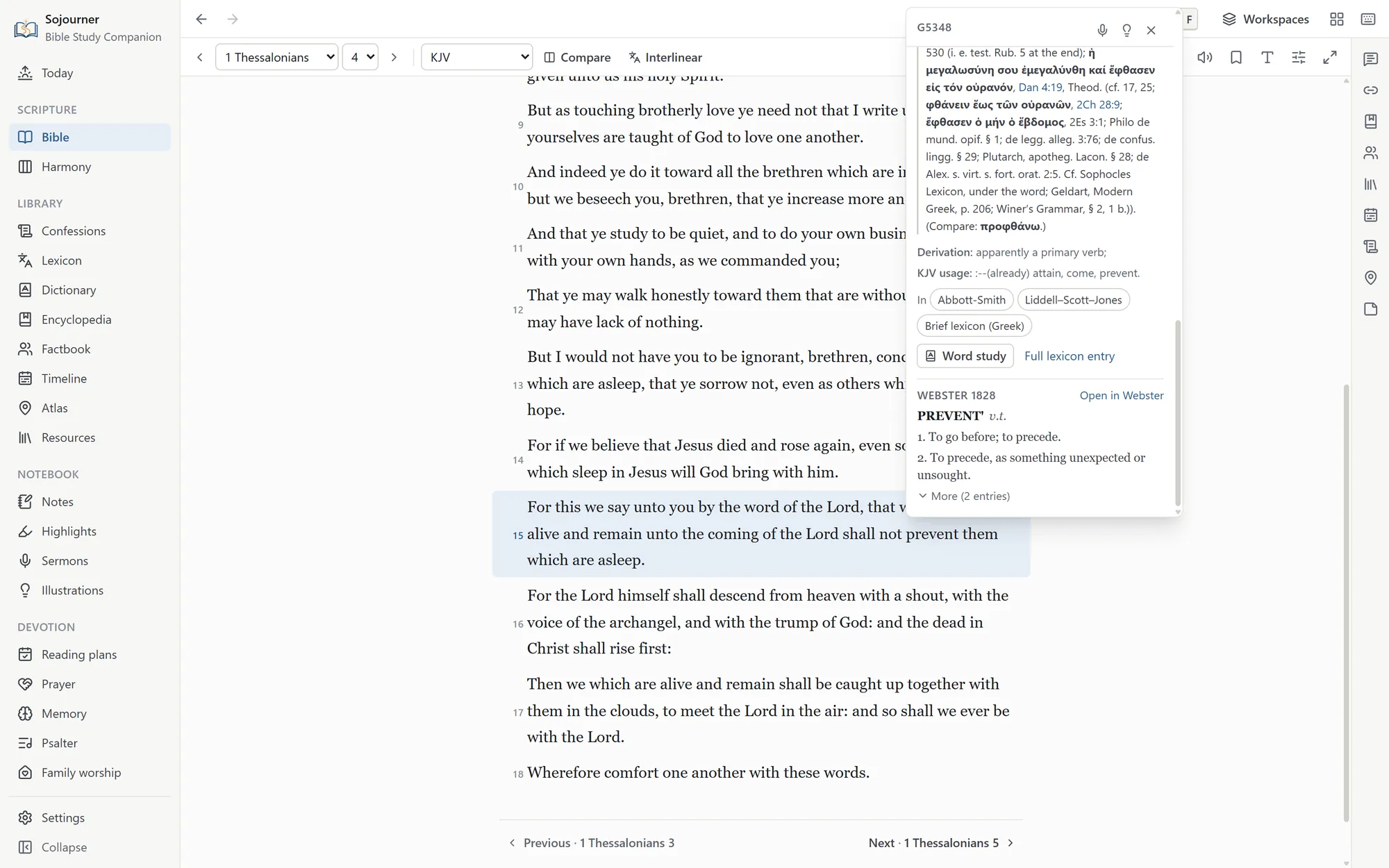
Many King James words meant something different four hundred years ago. Prevent
meant to go before, and conversation meant the whole way a man lived. Noah
Webster’s dictionary of 1828 still gives those older senses, and his Scripture citations
are linked. Double-click an English word and his entry is there beside the others, even for a
word as the King James spells it, such as letteth. The Dictionary page has a switch
between the Bible dictionaries and Webster.
Prevent in Webster’s 1828. To go before, as in Psalm 119, I prevented the dawning of the morning.1 Thessalonians 4:15. Double-click prevent and Webster is there beside the Greek, saying the word once meant to go before.
There is more on the shelves below. Once installed, their books are
read, searched, and linked exactly like the books you add yourself.
The book library
Four Shelves, and Your Own
The books come as four shelves, each a separate download on the releases page, so you take only
the ones you want and leave the rest. To install one, open Settings, choose Book library, and
pick Install from file. Once a shelf is in, that button reads Install or update a shelf. Each
shelf can be removed there too.
The Sojourner Library
Two hundred and seventy-one Puritan and Reformed works.
The Church Fathers
The writers of the early church. The Ante-Nicene Fathers, from before the Council of Nicaea,
and both series of the Nicene and Post-Nicene Fathers, as Roberts, Donaldson, Schaff, and Wace
edited them, with Lightfoot’s Apostolic Fathers. Thirty-eight volumes in all.
Ancient literature
The writers around the Bible. Josephus and Philo, 1 Enoch, and three Roman writers,
Tacitus on the reign of Tiberius, the letters of Pliny the Younger, and Suetonius’s
Lives of the Twelve Caesars.
The nineteenth century
Schaff’s History of the Christian Church and his Creeds of Christendom, and
Edersheim’s Life and Times of Jesus the Messiah, with his books on the Temple and on
Jewish social life.
Inside the program, Resources sorts every book by shelf and by subject. Books of sermons,
theology, commentary, and the Christian life each sit together, and the Fathers are grouped by
series.
Cited in your library
Beside each verse, a small count shows how many times the books on your shelves cite it. Click it for
the list, and click a citation to open the book at that page. It is a quiet way to find out who
else has stood over the verse you are reading.
Romans 8:28, cited 201 times in 86 books. Each book shows where it cites the verse, and a click opens it there.
Your own books and recordings
Bring in your own EPUB, PDF, and MOBI books and your own audio and video. All of it goes into
the search box and is scanned for the verses it cites. You can group it by author, by date, or
by topic. Recordings play at the speed you choose, and a passage can link straight to the
moment in a recording where it is discussed.
How it works
Panes That Follow Each Other
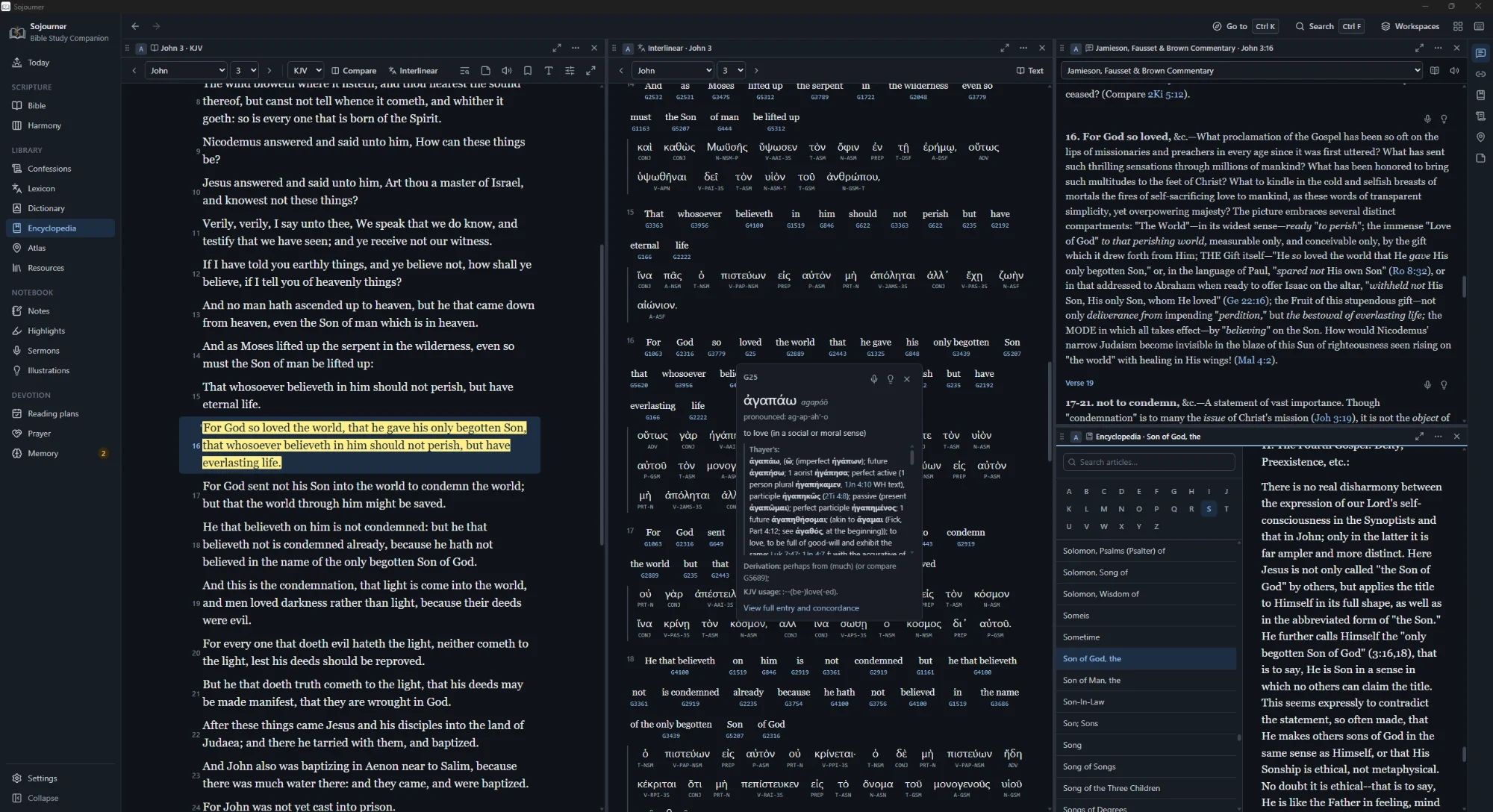
This is the part worth understanding, because it is what the picture at the top of the page is
showing. You can open up to eight panes and split the window however you like. Drag a pane to
dock it, stack tabs inside it, pick a ready-made arrangement, or save the whole layout as a named
workspace that survives a reinstall. The lists that sit beside a page, such as the
encyclopedia’s index or a commentary’s contents, can be narrowed or folded away, so
even a thin pane keeps room to read.
Then you link them. Click a verse in one pane and every linked pane turns to it. The
commentary, the cross references, the confession proofs, the encyclopedia article, and the atlas
map all land on the same verse at once. So do the people and places the verse names, its place
on the timeline, and the books on your shelves that cite it. You stop hunting and start
reading.
One click, and the whole shelf opens to the same page.
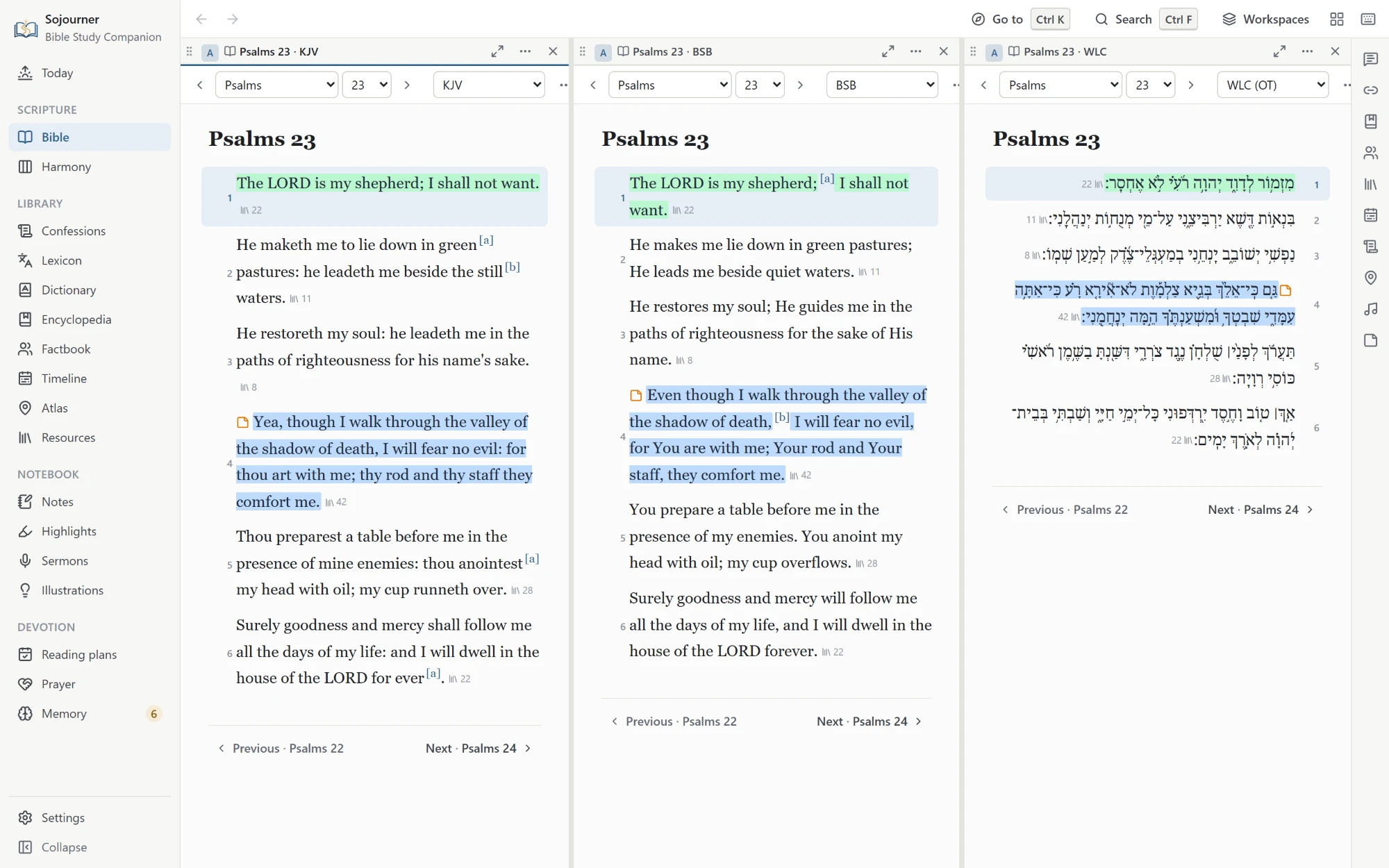
You can also set translations side by side, or hold one verse up against every translation
at once. Every Scripture reference anywhere in the program, in a commentary or a confession or
your own notes, shows the verse on hover.
Psalm 23 in the King James, the Berean Standard Bible, and the Hebrew, which reads right to left.
Greek and Hebrew
The Original Words, for People Who Have None
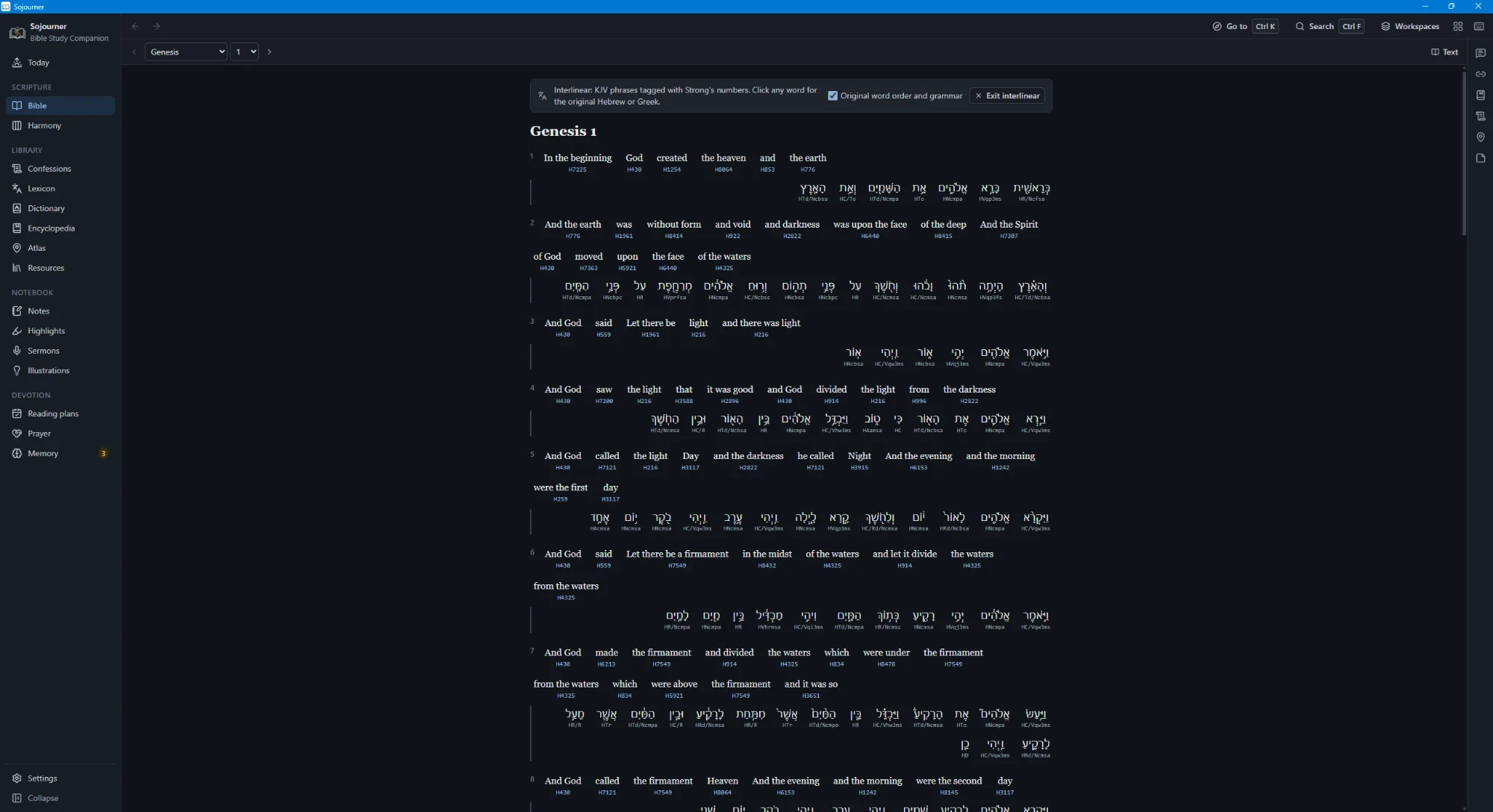
Every phrase of the King James text is tagged with its Strong’s number, through both
testaments. Turn the interlinear on and it is laid out the way Blue Letter Bible lays it out, in
a compact table with one row for each English phrase. Beside the phrase sit its Strong’s
number, the Hebrew or Greek word as the text has it, the word’s root and how to say it,
and its grammar. Small words the King James leaves untranslated, like the Greek article, share
the row of the word they go with. A switch puts the words back into the original order when you
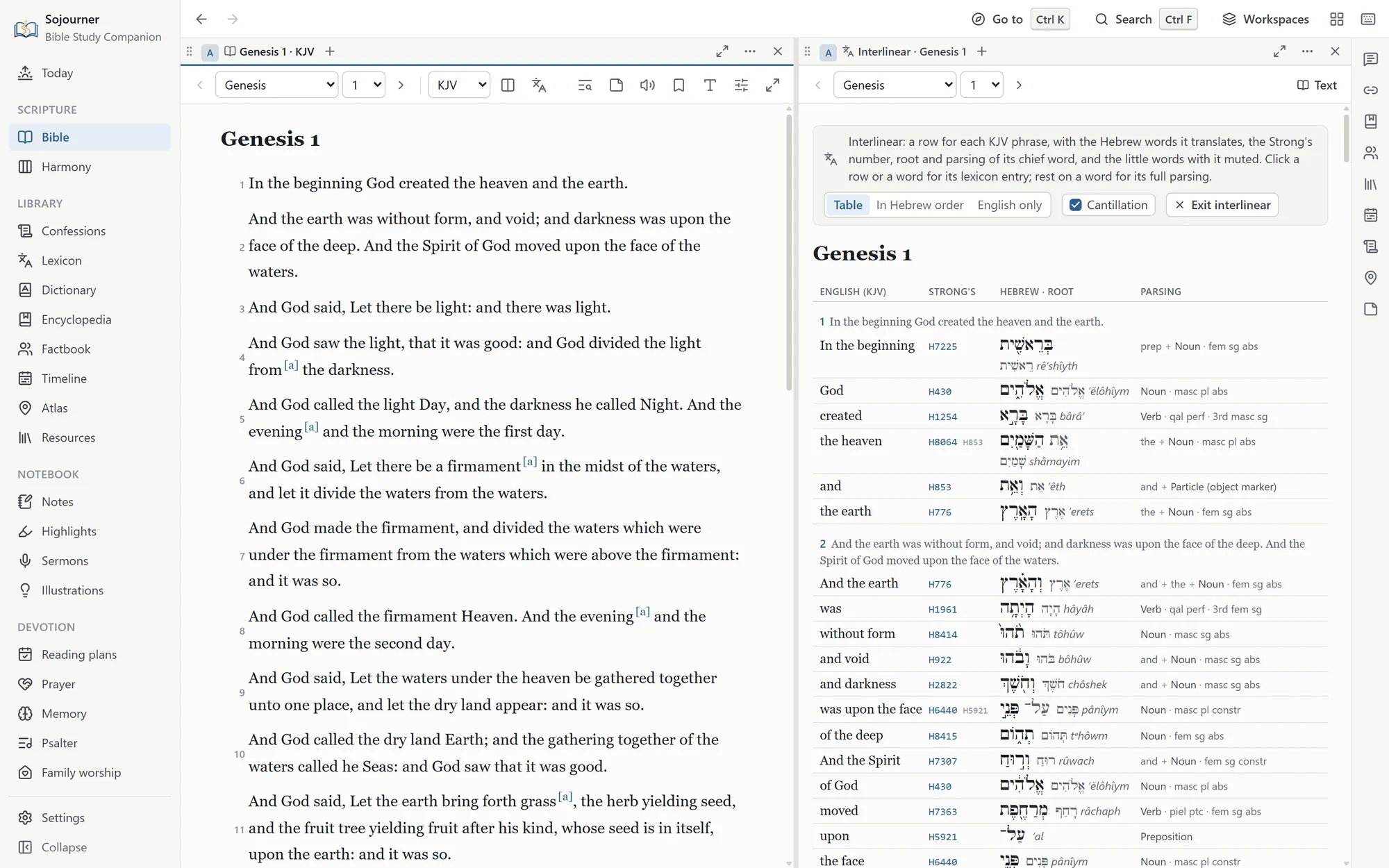
want to see the sentence as it was built, and another hides the Hebrew accent marks while
keeping the vowels.
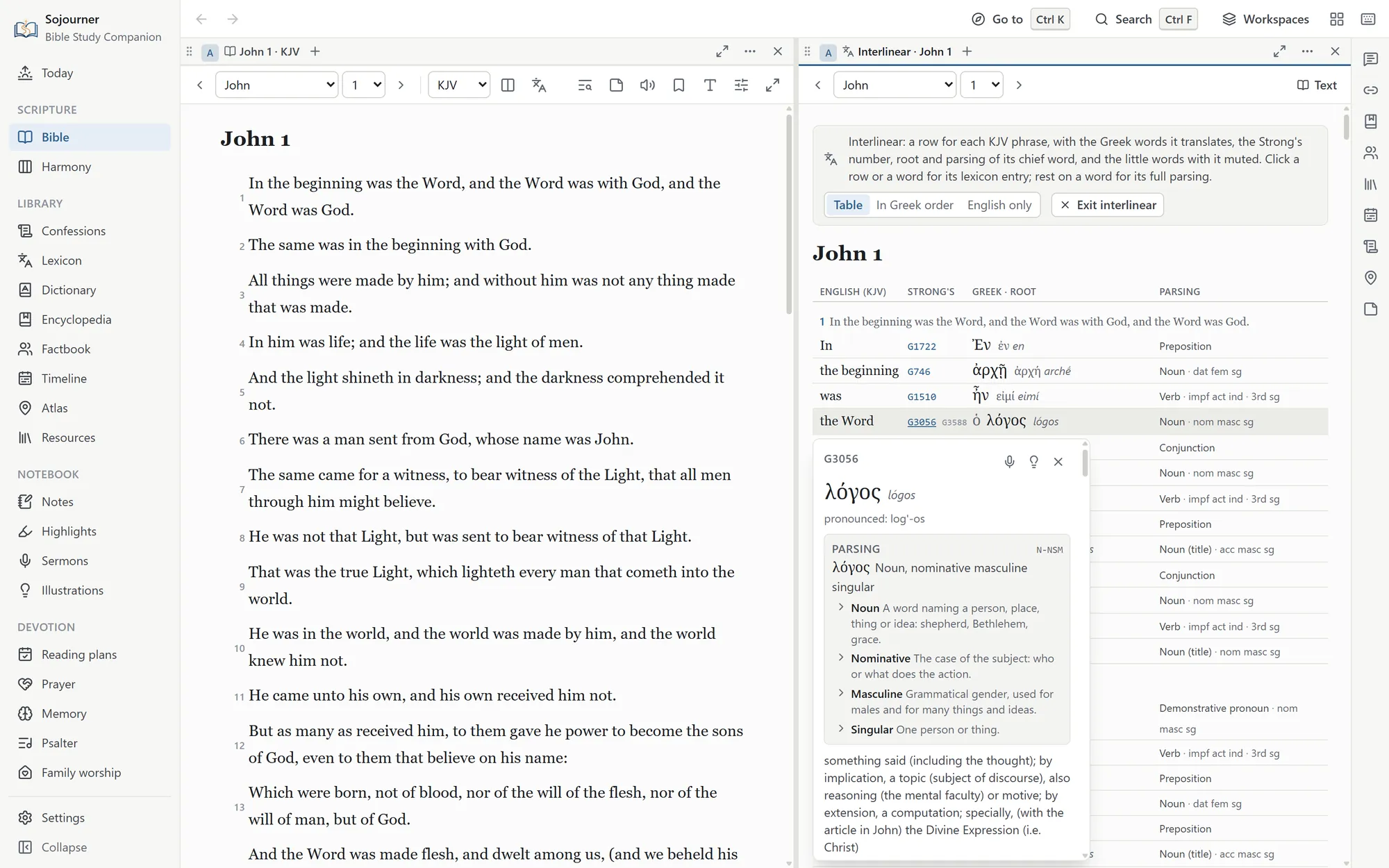
John 1 in the interlinear. A row for each English phrase, with its Strong’s number, the Greek and its root, and its grammar.Genesis 1 in Hebrew. The Cantillation box shows or hides the accent marks and keeps the vowels.
The grammar is spelled out in plain English, such as aorist active indicative, third person
singular, rather than in code letters. Hover over a word to see it, or open the word’s
card, where a Parsing section explains each term. It tells you what the aorist is, what a piel
does, and why a noun is genitive. The Hebrew and Greek were checked word by word against their
sources through both testaments, and a new Hebrew font sets the vowel points where they
belong.
The card for logos. The Parsing section says what each term means.
Double-click any word, anywhere in the text, and its entry opens in the lexicon you choose.
You can search the Greek and Hebrew without typing accents or vowel points.
Word study
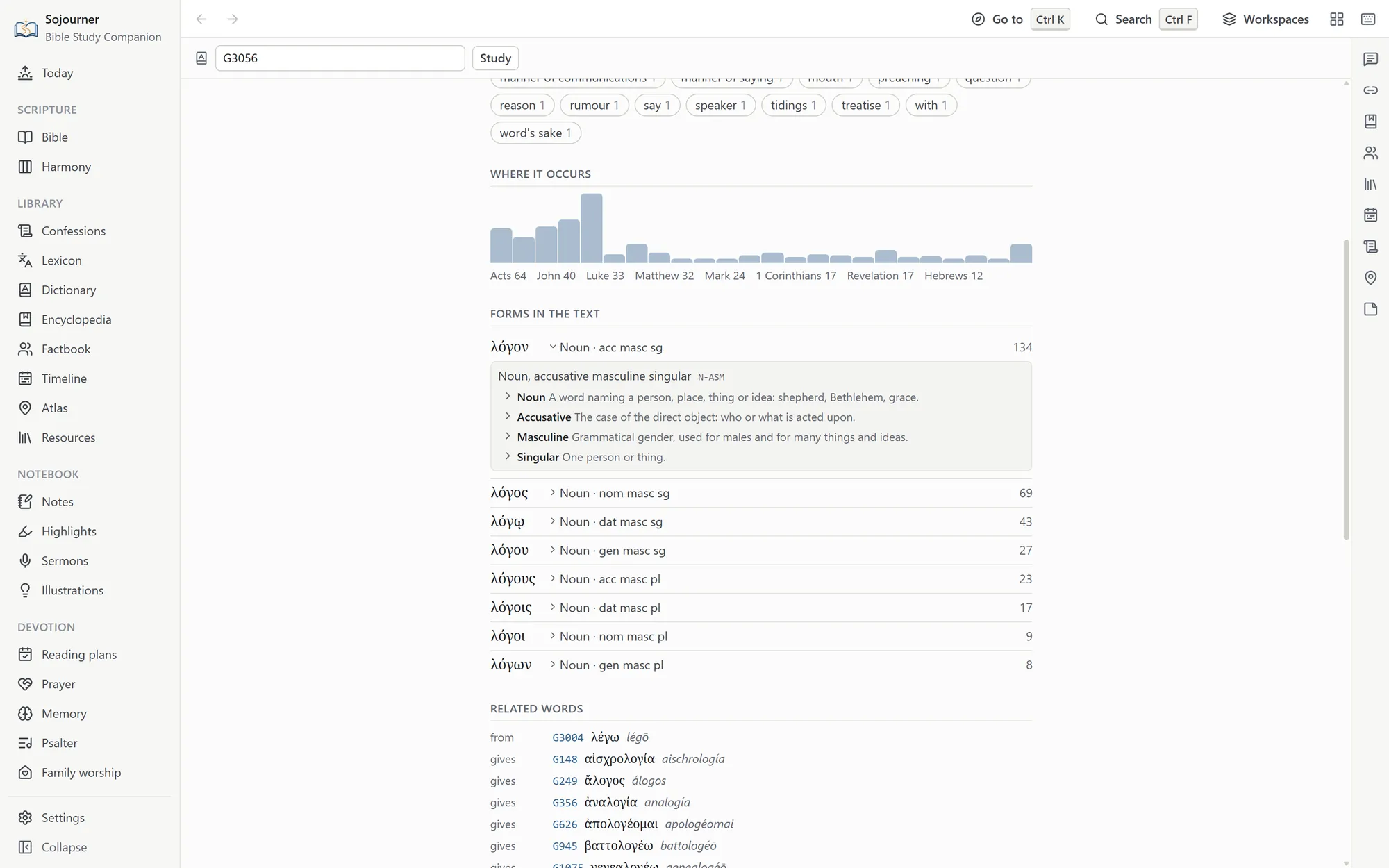
Pick any Hebrew or Greek word and Sojourner lays out the facts about it. How often it occurs,
how the King James renders it, the forms it takes and the grammar of each, the words related to
it, and every place it stands.
The word study for logos. Every form of the word, how often each one stands in the text, and what its grammar means.
Search by grammar
Every Hebrew and Greek word is parsed, which means its grammar is labeled, such as its tense
or whether it is a command. Search by grammar finds every word of one kind, such as every
command in Ephesians. You choose from lists rather than typing code letters, so you do not need
to know how the labels are written.
Where the Greek editions differ
Set the five Greek editions side by side on a verse and see where they read differently. At
1 John 5:7, the words about the three that bear record in heaven, known as the Comma Johanneum,
stand only in the Textus Receptus.
None of this asks you to have studied the languages. That is the point of it. A man with a
concordance and some patience has been able to do real work in the text for two hundred years,
and this only makes the same work quicker.
Who, where, and when
The People and the Ground They Walked
A page of text cannot easily show you who a man was, where something happened, or how it lines
up with everything else happening at the time. The Factbook, the timeline, the atlas, and the
harmonies are for that.
The Factbook
A page for each of four thousand two hundred and seventy five people, places, and things in
the Bible. The Bible has several men named Zechariah, and the Factbook tells them apart by the
verses that name them. Each one gets his family, every verse, and what the encyclopedia and the
dictionary say about him. Double-click a name in the text and it opens the person that verse
means.
The timeline
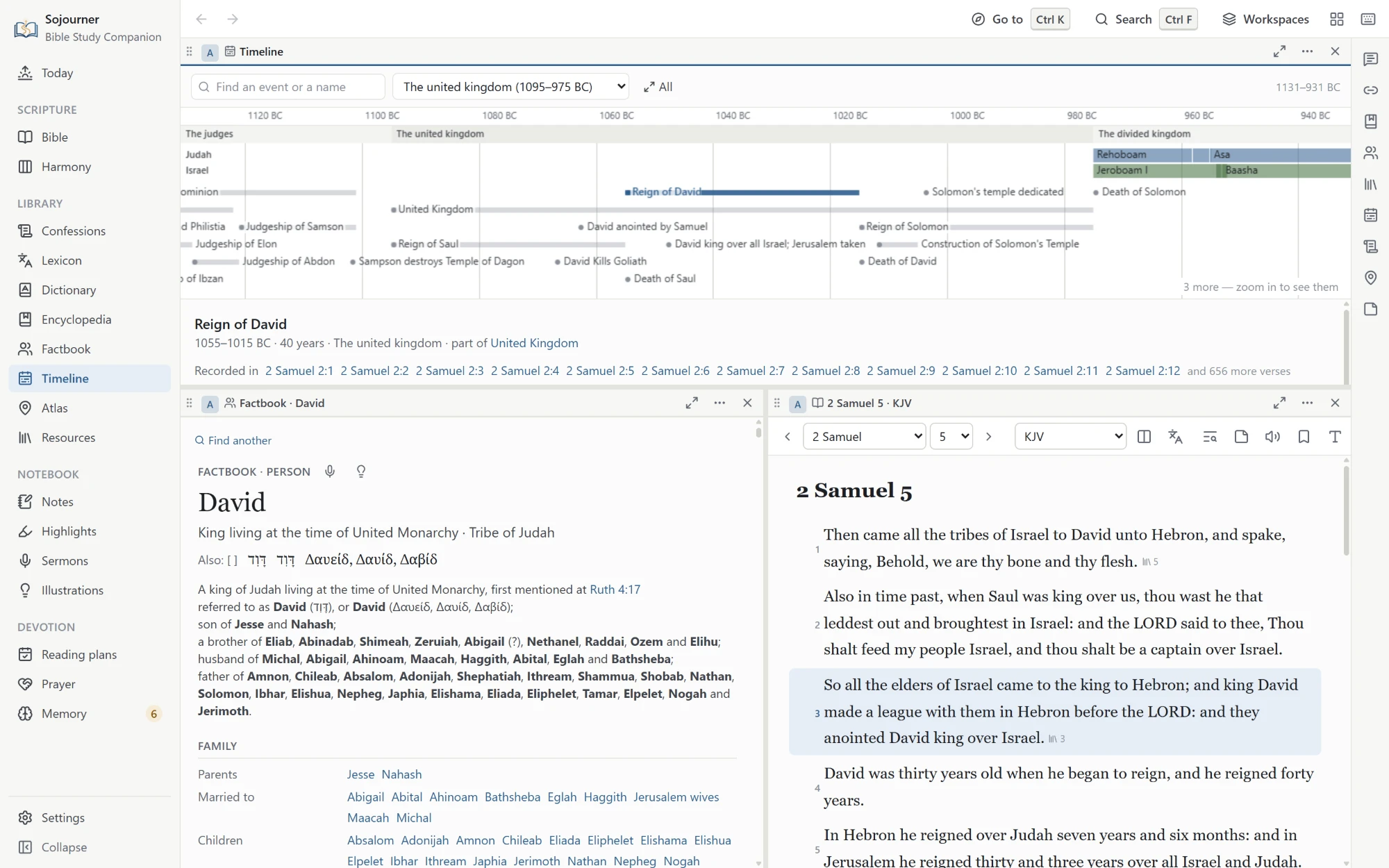
Four hundred and sixty four events, from the Creation to Paul in Rome, on a line you can zoom.
The eras are marked, the kings of Judah and Israel run side by side, and a strip beside the text
shows where the chapter you are reading falls. The dates are approximate, taken from a
traditional chronology.
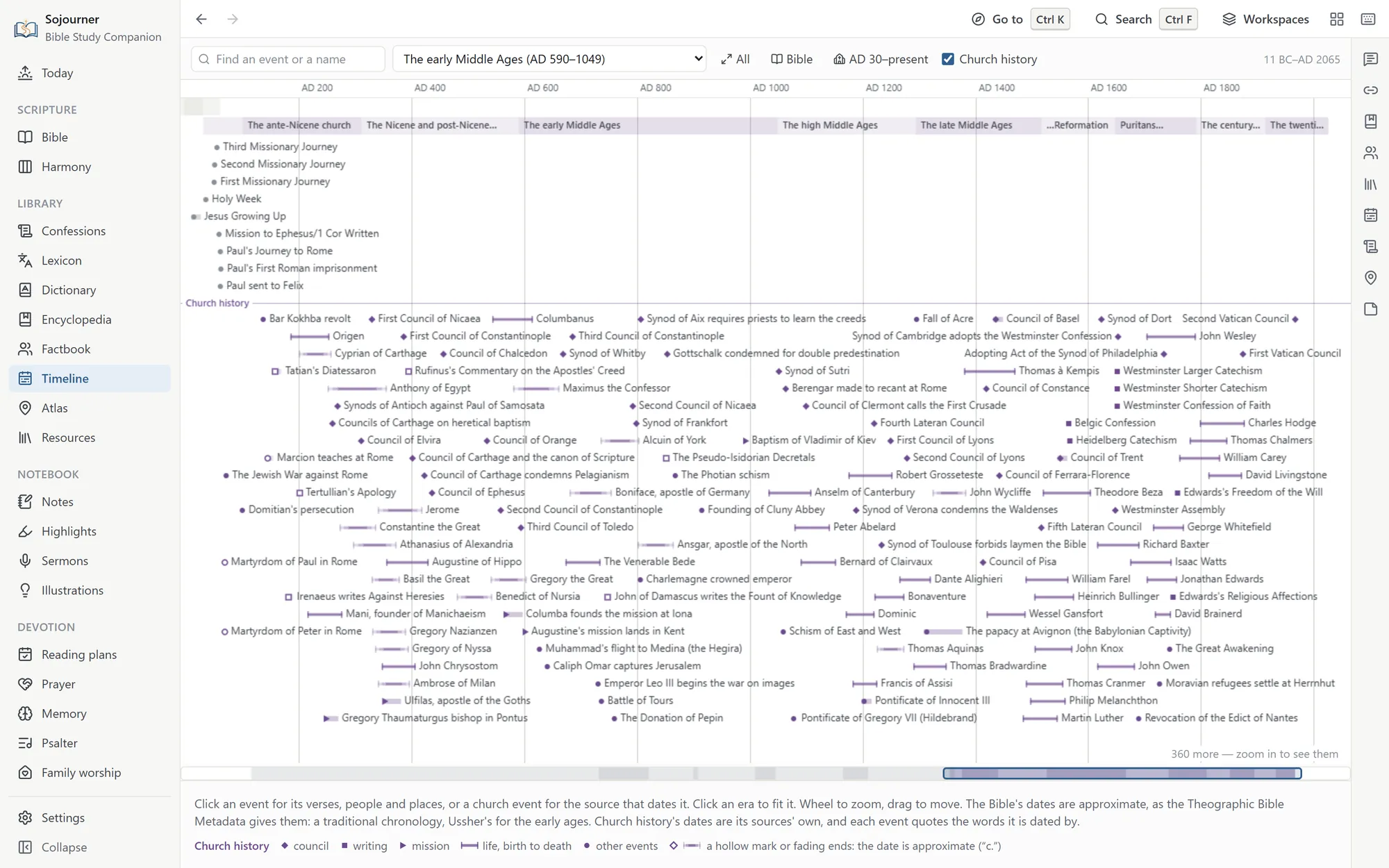
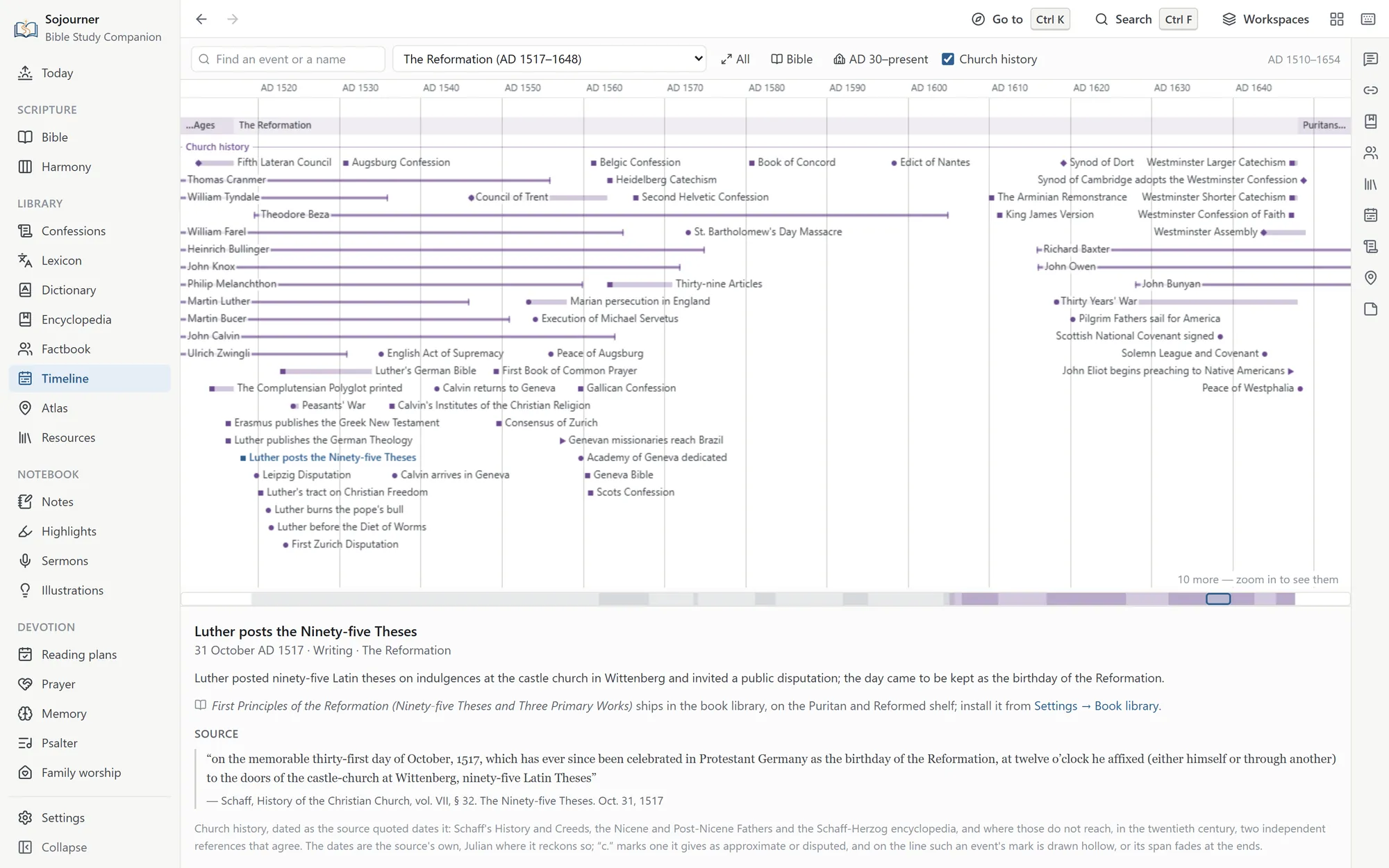
Turn on Church history and the line runs on past the apostles to the present, with two
hundred and ninety-six events in ten eras. There are councils, creeds and confessions, lives,
writings, and missions. Every date comes from a source, mostly Philip Schaff’s History of
the Christian Church, and each event quotes it. Where the sources give no date, the event is
left out rather than guessed. A creed or confession opens its text, and a writing opens its
book if it is on your shelves. A strip beneath the timeline shows where you are, and you can
drag it to move along.
Church history on the timeline, from the councils of the early church to the Westminster Assembly and after. The strip along the foot shows where you are.Luther posts the Ninety-five Theses, with the words from Schaff that date it.The reign of David on the timeline, his page in the Factbook below it, and 2 Samuel 5 open beside the Factbook.
The atlas
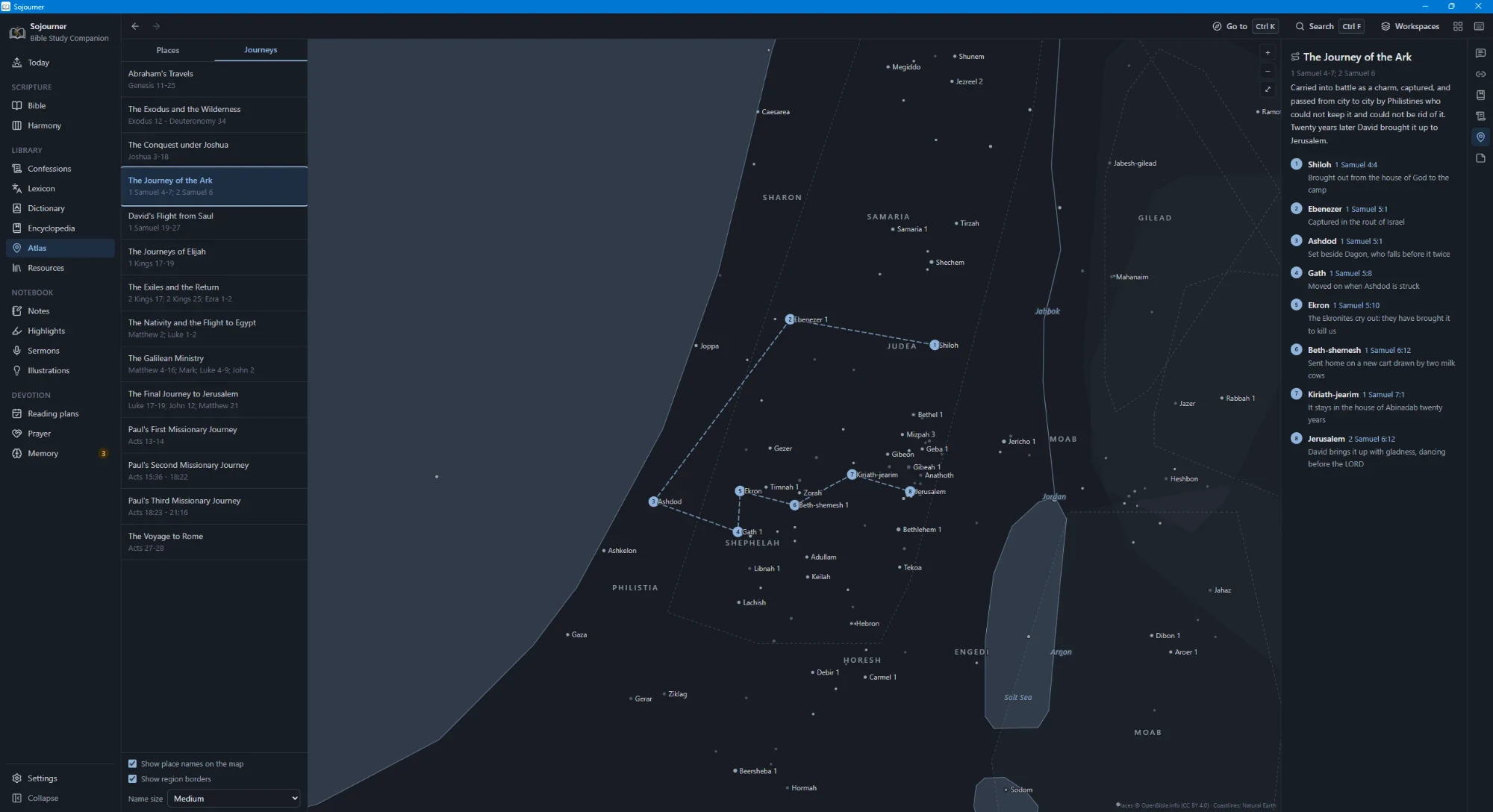
One thousand three hundred and forty two places, each with its coordinates, its modern
identification where there is one, and every verse that names it. Fourteen journeys are traced
across the map, from Abraham leaving Ur to Paul reaching Rome, and each stop carries its own
reference and a line saying what happened there. The old regions are shaded as a soft wash inside a dashed line, since
no one ever surveyed their borders and a crisp line would claim more than anyone knows.
Paul’s second missionary journey. Each stop is numbered, with its verse and what happened there. Place data from OpenBible.info, coastlines from Natural Earth.
The harmonies
Two harmonies of the Gospels, both laid out in four columns. Robert M. Sutherland’s of
2020 runs to a hundred and thirty six events, and A. T. Robertson’s of 1922 to a hundred
and eighty five. Each event is titled and paired with where it is told in Matthew, Mark, Luke,
and John, with Acts 1 brought in for the ascension. Where an event appears in more than one
Gospel, one button sets the accounts side by side.
The feeding of the five thousand, with Matthew, Mark, and Luke set side by side.
One Search Box
One box searches Scripture, the commentaries, the lexicons, the Factbook, the confessions, the
encyclopedia, your books, and your own notes, prayers, sermons, and illustrations, with the same
rules everywhere.
Put an exact phrase in quotation marks. Ask for either of two words with OR, or leave a word
out with a minus sign. Group words in parentheses, ask for words near each other, match the
start of a word, or, for those who know them, use regular expressions. A plus sign asks for the
exact form and its capitals, so +LORD finds the covenant name as the King James prints
it, and skips the ordinary word Lord.
You can also narrow a search by typing a filter into the box itself. There are filters for a
book, a translation, a Strong’s number, the words of Christ, and the verses you have notes
on, and they are saved with the search. Older spellings match, so shew finds
show. Results can be counted by book and by translation, or laid out like a printed
concordance, one line for each place the word appears.
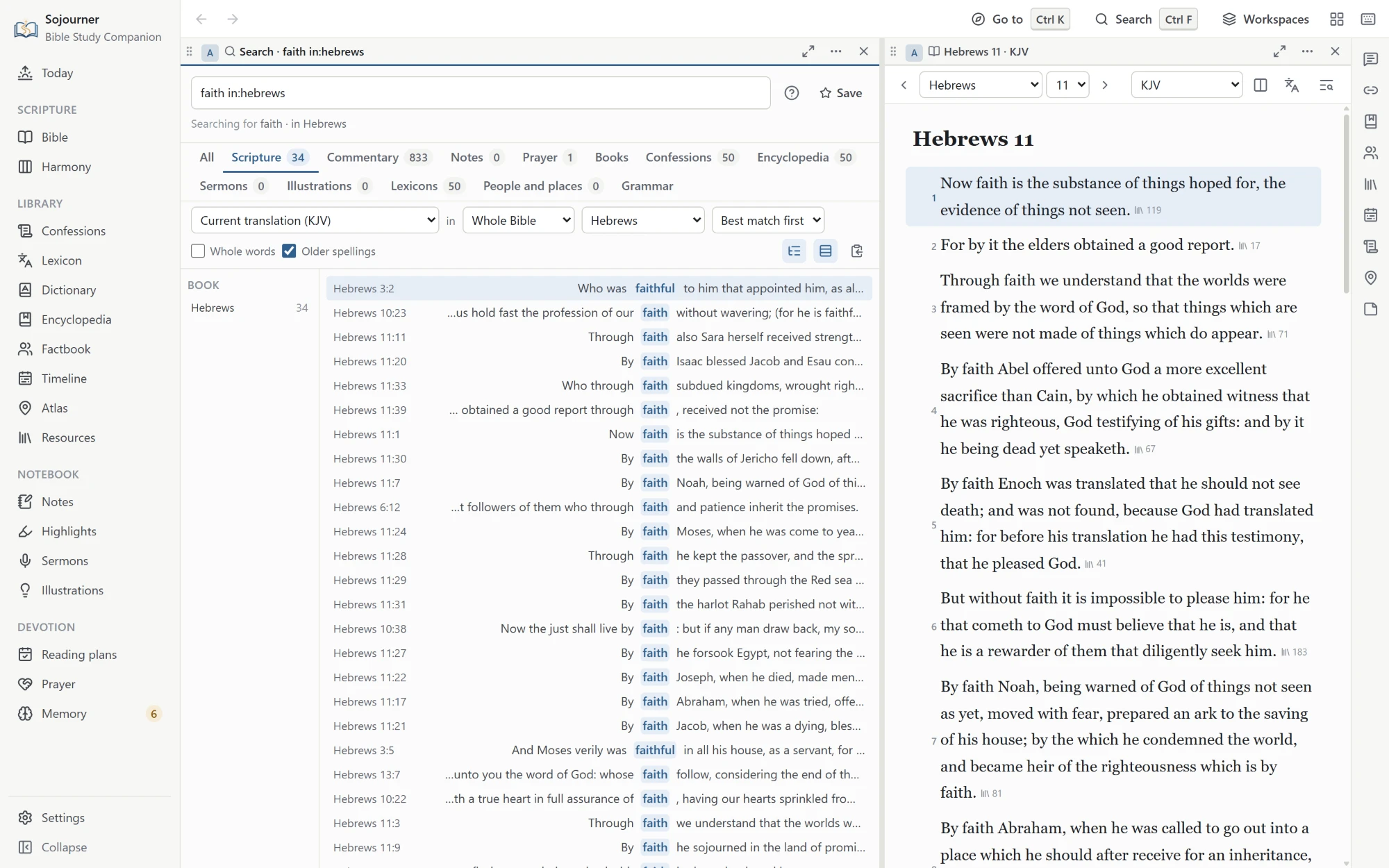
Faith, in Hebrews. Each tab counts what the same search found elsewhere, and the verses line up like a concordance.
Reading
Book and chapter navigation, paragraph mode, verse numbers on or off, red letters, five named
highlight colors and an underline, bookmarks, a find bar for the open chapter, a focus mode
that clears everything else away, and printing.
Seven themes, including sepia, true black, and two built for high contrast. A font made for
dyslexic readers, text you can size, and reduced motion for anyone who needs the screen to hold
still.
The voice that ships with the program will read any chapter, commentary, or book aloud. In a
book it starts at the page you are on and carries on from there, and the page follows the voice.
Select a passage and choose Read aloud from here to start somewhere else. A commentary is read a
verse or a paragraph at a time, and a list in the player jumps to any piece of it.
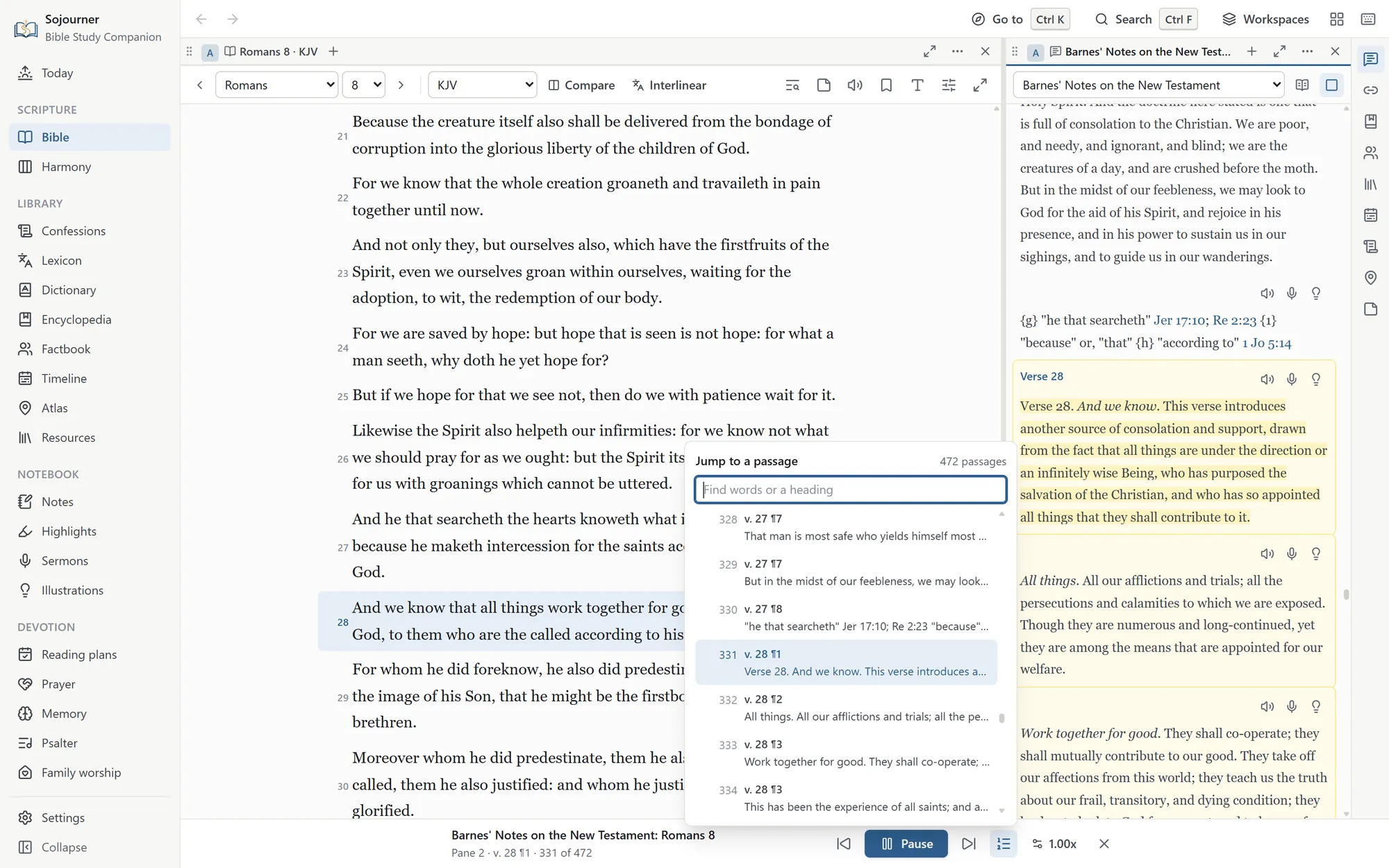
Barnes on Romans 8:28, read aloud. The Jump to a passage list finds any part of the note by its words.
Notes That Stay Yours
Write on a verse, on a chapter, or on a highlight. Templates are there when a blank page is the
problem, for observation and interpretation and application, for question and answer, for a
sermon outline, for a prayer in response. Type a reference inside any note and that verse is
marked in the text from then on.
Highlighting works the same way. Five colors and an underline, each one named for what it
marks rather than for its color. Promise in yellow, command in green, doctrine in blue, warning
in orange. Then you can pull up every promise you have ever marked, across every book, in one
list.
The Mine pane gathers everything you have written on the chapter that is open. Notes, prayers,
sermons, and illustrations you delete wait thirty days in a trash before they are gone.
For preachers
Preparing and Preaching
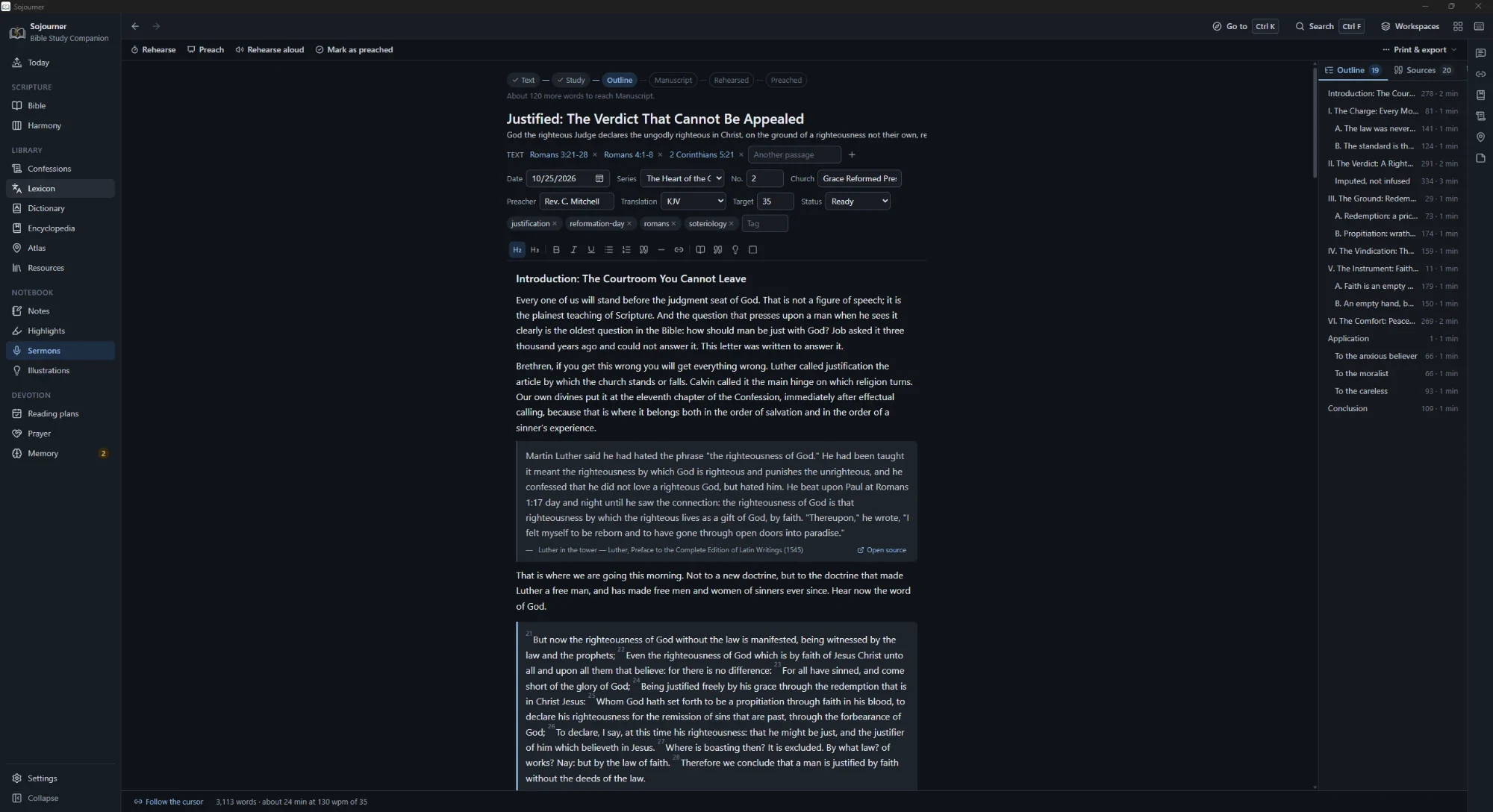
The sermon editor treats your points as the outline, so the structure comes out of the
manuscript instead of being kept beside it. Passage blocks render live in the translation the
sermon is set to. Drag a point to a new place in the outline and it takes its sub-points, and
everything written under them, along with it. Open another page while you write and it comes up
in a new tab beside the sermon instead of in its place, so the manuscript is only a click
away.
Part of a point can be set apart as a block for the explanation, the illustration, or the
application. A block can also mark a transition, or carry a name you give it. Each kind has its own color,
and the colors carry through to preaching mode and print, so you can find the application
under any point at a glance.
Explanation, illustration, and application, each in its own color under the point it serves. The outline beside the manuscript gives the words and minutes of every point.
Every verse, commentary entry, confession section, lexicon entry, word study, encyclopedia
article, and book selection carries a small microphone button. Press it and that text drops into
the open sermon with its source line already attached. You never lose track of where a quotation
came from.
Thoughts about a text seldom wait for the week you preach it. A single shortcut catches a
sermon idea from anywhere in the program, and a selection in the Bible can start one with its
verses already attached. Ideas wait in an inbox beside every manuscript and on the Sermons page,
until you drag one into a sermon or start a new sermon from it.
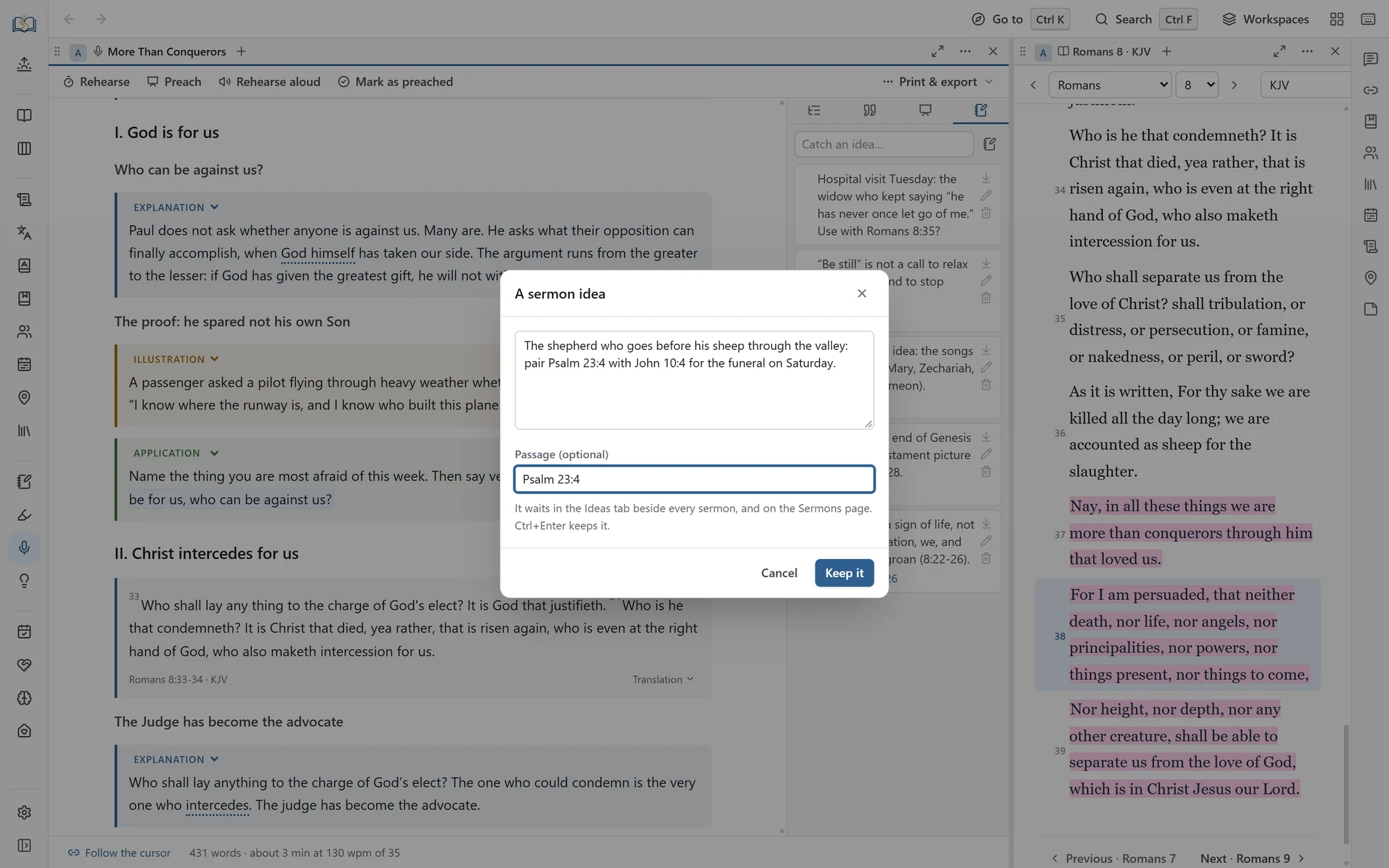
Catching an idea for a funeral on Saturday. Keep it, and it waits in the Ideas tab beside the sermon and on the Sermons page.
Illustrations go into a file of their own, each with where it came from and where you have
used it. When you reach for one you have already told in this series, it says so before you
put it in.
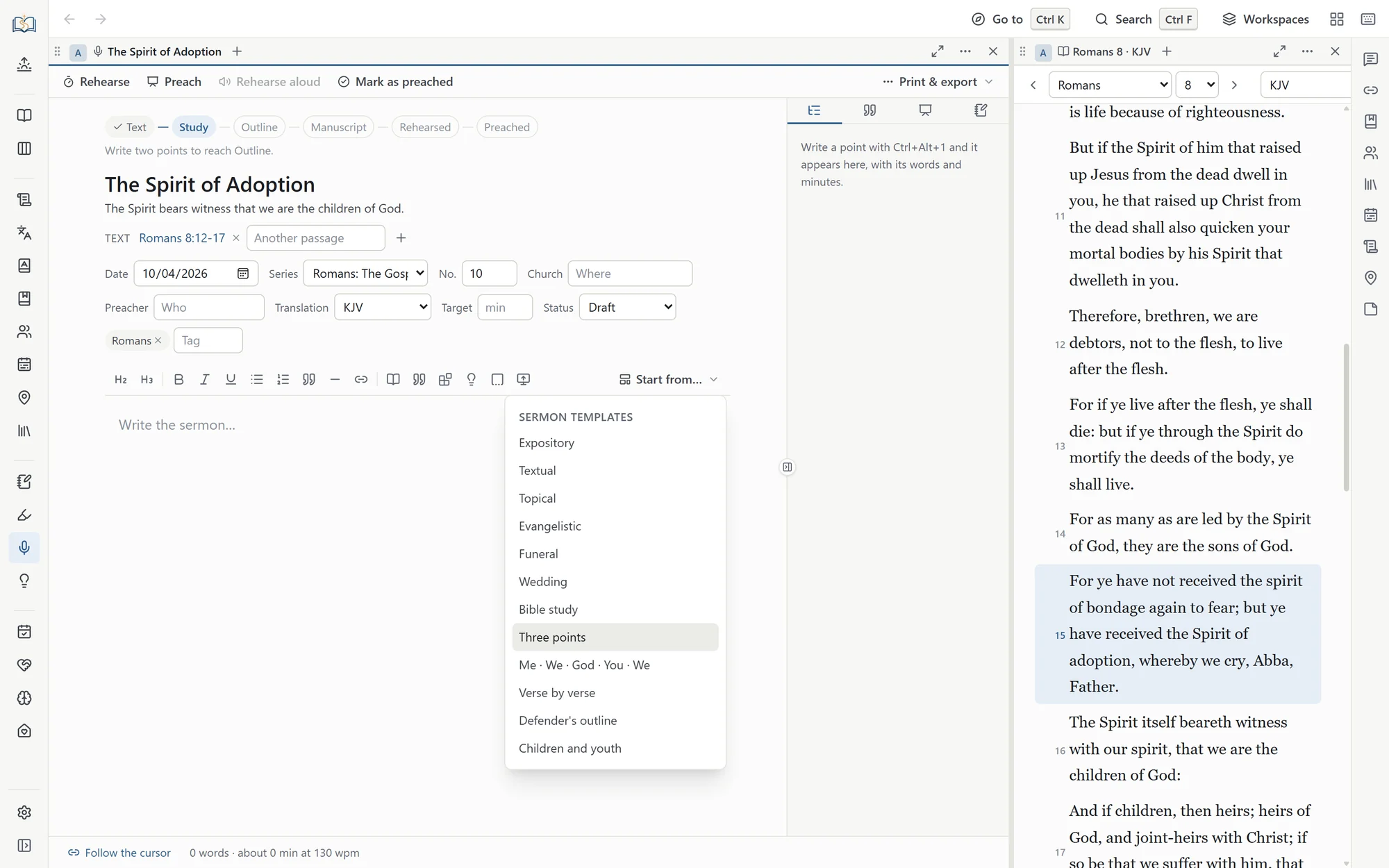
Twelve templates give you somewhere to begin when the page is blank. One sets out three points,
each with an explanation, an illustration, and an application. Others give a verse-by-verse
outline, a defender’s outline for answering an objection, and an outline for preaching
to children and youth.
A blank page and the twelve templates you can start it from.
Around that sit a six-stage preparation track, timed rehearsals that measure your speaking
rate, and a preaching mode with pulpit-sized type and a clock. It will generate slides and
export them to PowerPoint, and any line you mark gets a slide of its own. It builds fill-in
handouts, prints, and exports to Markdown. Sermons group into a series with a reading plan for
the congregation, and a series can give the church a verse a week to learn, printed on cards to
hand out. When a sermon has been preached, there is a place to write down how it went.
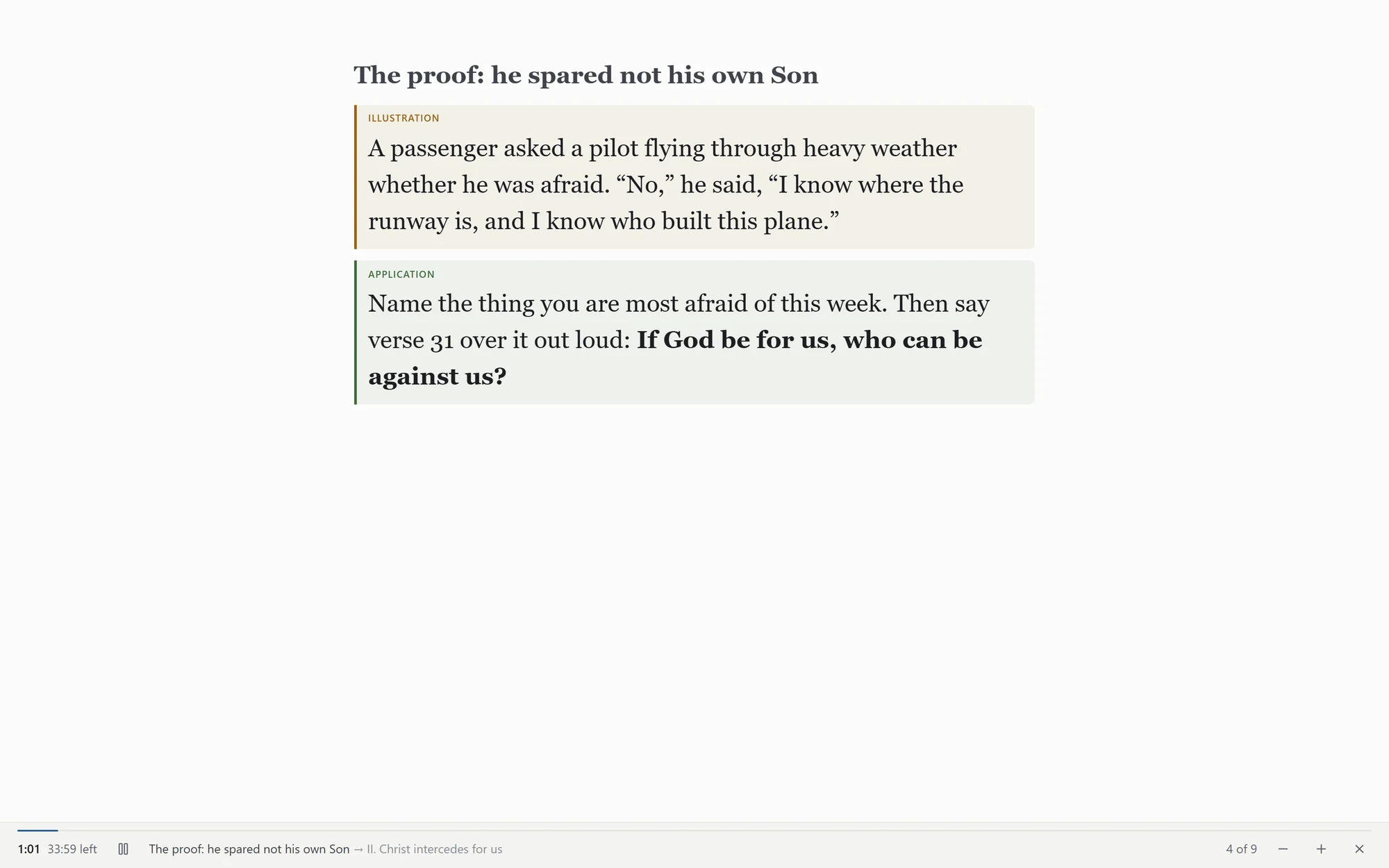
Preaching mode keeps the colors of the blocks. The bar at the foot keeps the time, counts down what is left, and shows the point that comes next.
If you preach from a phone or a tablet, there is a podium file. It is the whole manuscript as
one small web page with every passage written into it, so it needs no internet and no program
but a browser. A tap turns the page, the text grows or shrinks to suit your eyes, and a clock
keeps time against the minutes you meant to take.
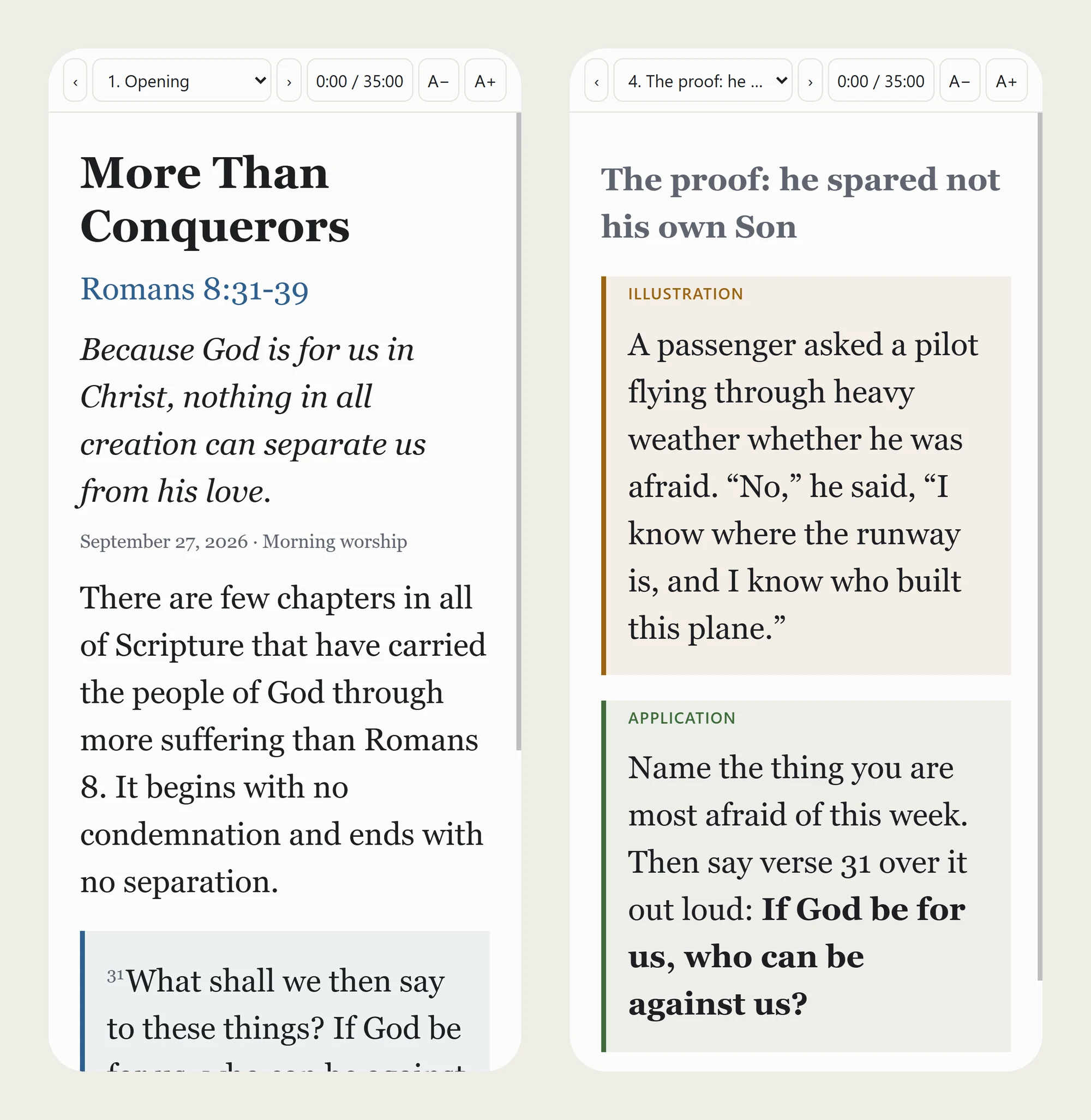
The podium file on two phones. The title and the opening on one, and a point with its blocks on the other.
The Ordinary Days
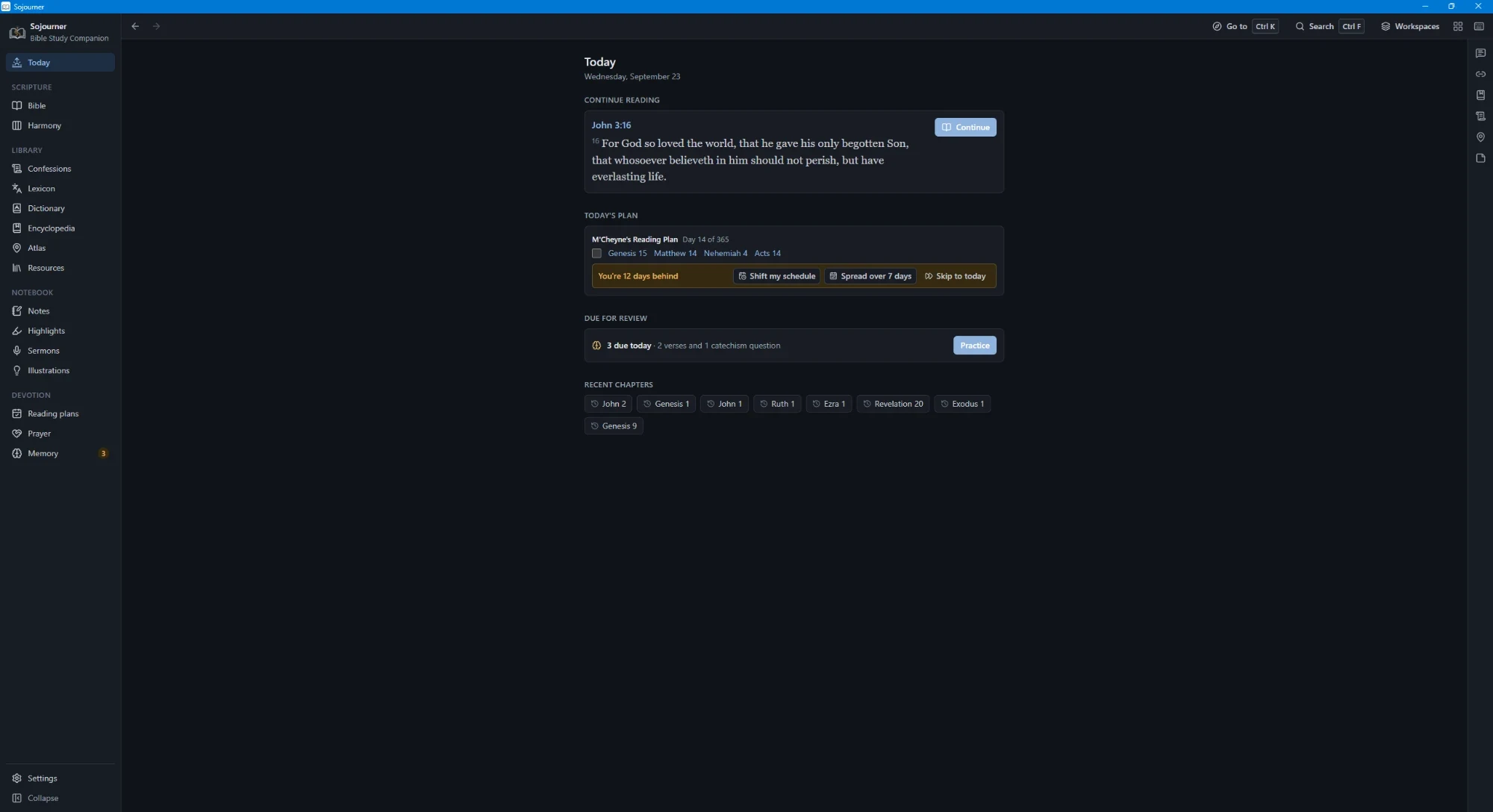
The Today page gathers what is actually in front of you. Where your reading left off,
today’s portion of your plan, the sermons coming up, the memory cards that are due,
and the people you meant to pray for. A new install opens on it. Once your household has begun
family worship, it also shows what you will read and learn the next time you gather.
Today, with the reading, the plan, the sermons coming up and how far along each one is, and the verses due.
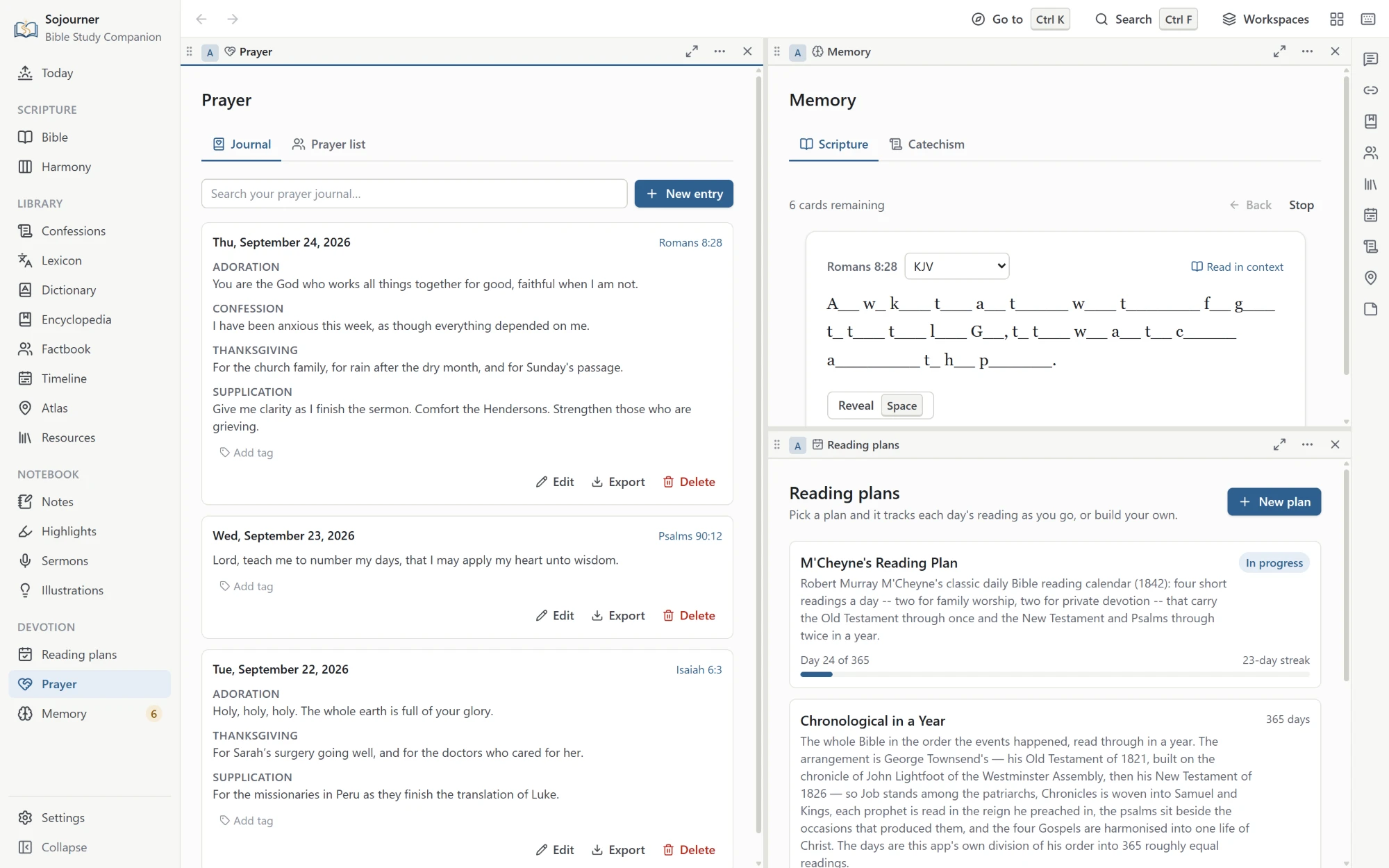
Reading plans come with catch-up tools for the weeks you fall behind, and you can build your
own. The prayer journal follows the ACTS pattern, keeps a list of people, nudges you toward the
ones you have not prayed for in a while, and prints.
Memory covers Scripture and the catechism together, on a spaced repetition schedule, with three
ways to practice. One leaves you only the first letter of every word, which is harder than
it looks and works better than reading it over again.
A whole psalm or chapter is learned a part at a time. The next part comes once you have
recalled the one before twice in a row, and last of all you say it through from the top. A card
can also be turned around, to show you the words and ask where they are found. Ready-made sets
will get you started, from the Romans Road and the Ten Commandments to a handful of short verses
for little ones.
The Heidelberg Catechism and the Catechism for Young Children can be learned beside the Shorter
and the Larger. For the Westminster catechisms, one button turns a proof text for each question
you are learning into a Scripture card. The program will read a Scripture card aloud, or every
one that is due, so you can practice with your eyes shut or your hands busy. In place of a streak there
is a calendar of the days you practiced.
The prayer journal in the ACTS pattern, a memory card with first letters only, and the reading plans.
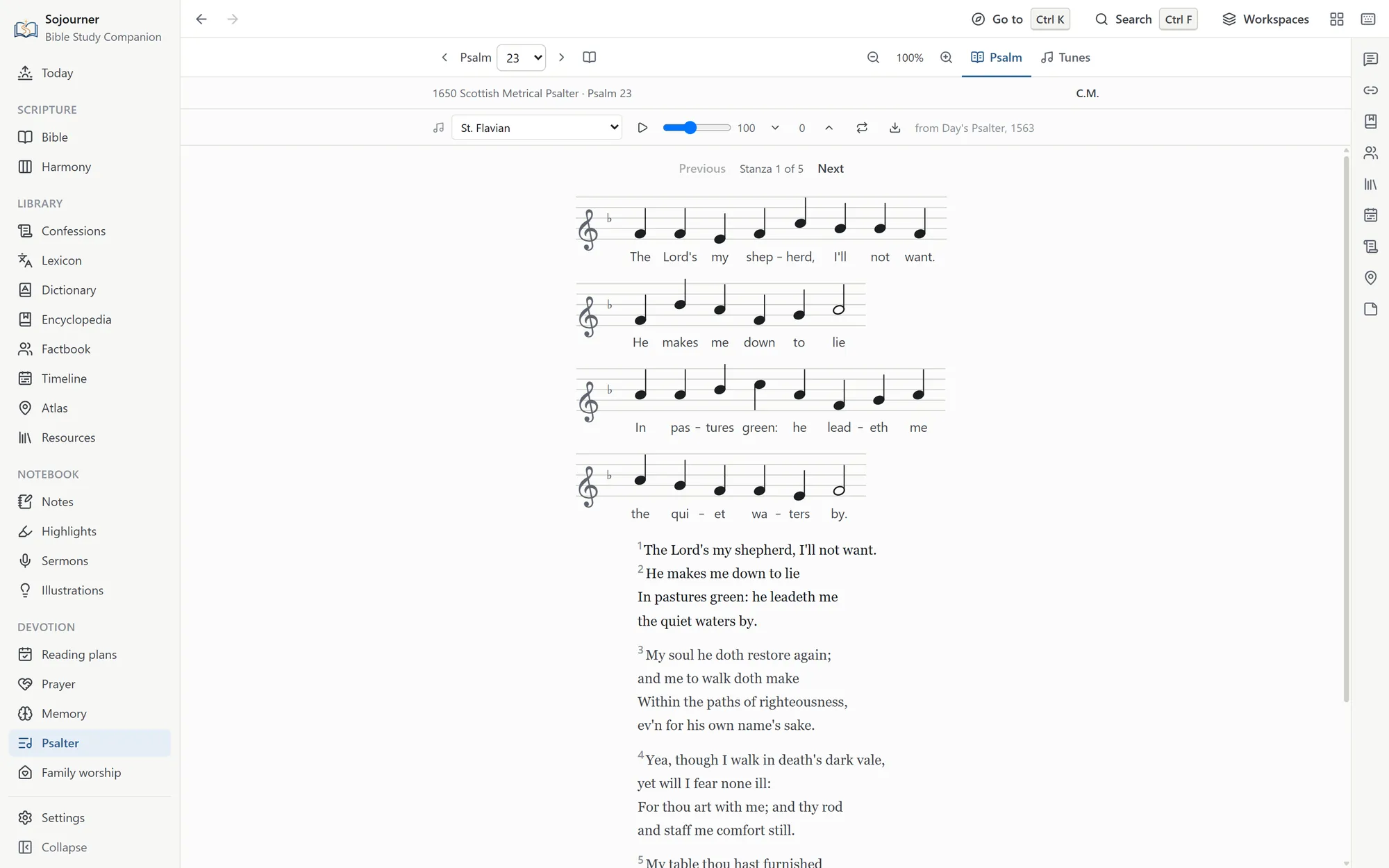
The Psalter is there for singing too, on a page of its own under Devotion. Open a psalm, choose
a tune, and press play. The words are set under the melody one stanza at a time, and each psalm
remembers the tune you last sang it to. The page opens on the last psalm you had, the music can
be made larger, and a long line breaks onto a second staff in a narrow pane.
The words are set line by line as the book of 1650 prints them, checked against two old
editions and the Free Church of Scotland’s text. Nothing is modernised, so
chuse, shew, and heav’n stay as the book has them.
Psalm 23 on the Psalter page, set to St. Flavian, with the first stanza under the notes.
For the household
Family Worship
Matthew Henry preached a sermon on family religion and called it A Church in the House.
Sojourner has a page for keeping that church, and it is made for the one who leads it, who may
feel the least ready of anyone.
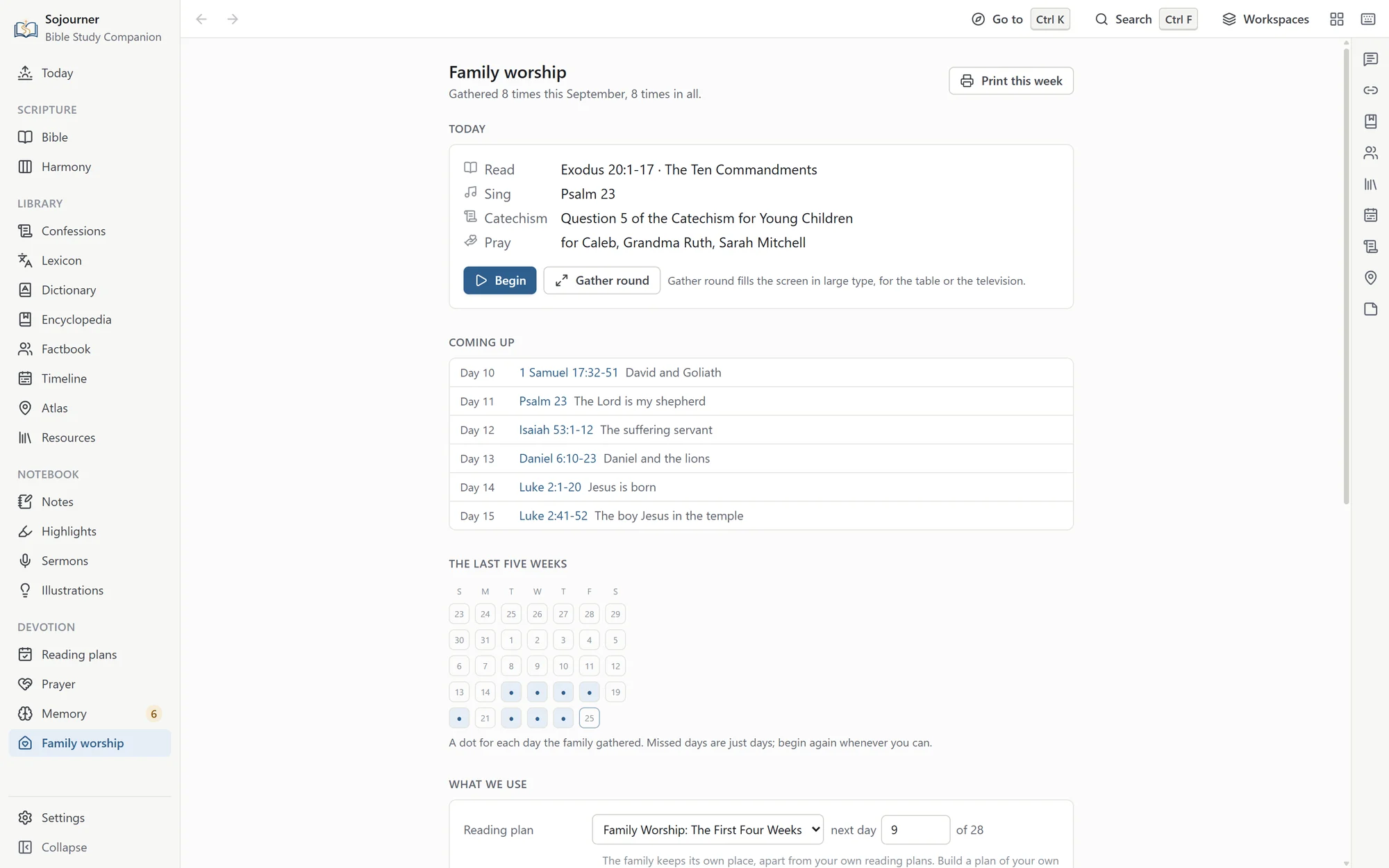
A gathering takes a few minutes. You read a short passage, sing a psalm, go over the
catechism, and pray. If you choose a verse to learn by heart, you say it together before you
pray. The Family worship page walks through each step in order, so nothing has to be prepared
ahead and no one has to preach.
The Family worship page. Tonight’s reading, psalm, catechism question, and names to pray for, the readings still to come, and a dot for each day the family met.
And these words, which I command thee this day, shall be in thine heart: And thou shalt teach them diligently unto thy children, and shalt talk of them when thou sittest in thine house, and when thou walkest by the way, and when thou liest down, and when thou risest up.
Deuteronomy 6:6-7 (KJV)
If you have never done this before, begin with the first four weeks. That is twenty-eight
short readings that tell the story of the Bible, from the creation to the new creation. Each
week has a psalm from the 1650 Psalter with its tune to play, and a new catechism question comes
every other time you meet. You start with the Catechism for Young Children or the Shorter
Catechism. The Heidelberg can be chosen in their place, and the Larger, with its long answers,
is there for when the children are older.
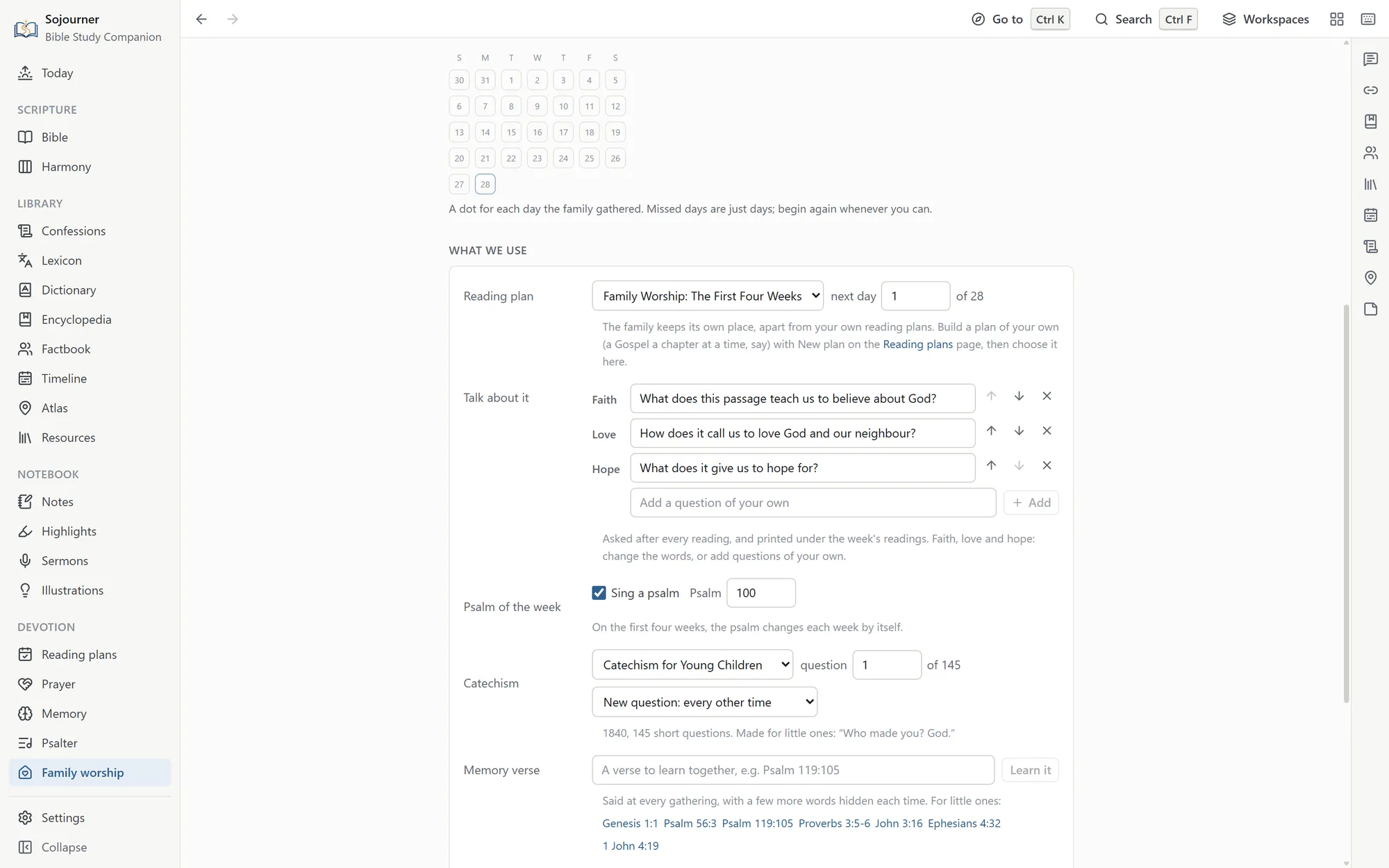
Each reading comes with three questions to talk over, one each for faith, love, and hope. What
does this passage teach us to believe about God? How does it call us to love God and our
neighbour? What does it give us to hope for? You can reword them, add one, or take one away in
the family settings, and your own go on the printed sheet too. Tonight’s
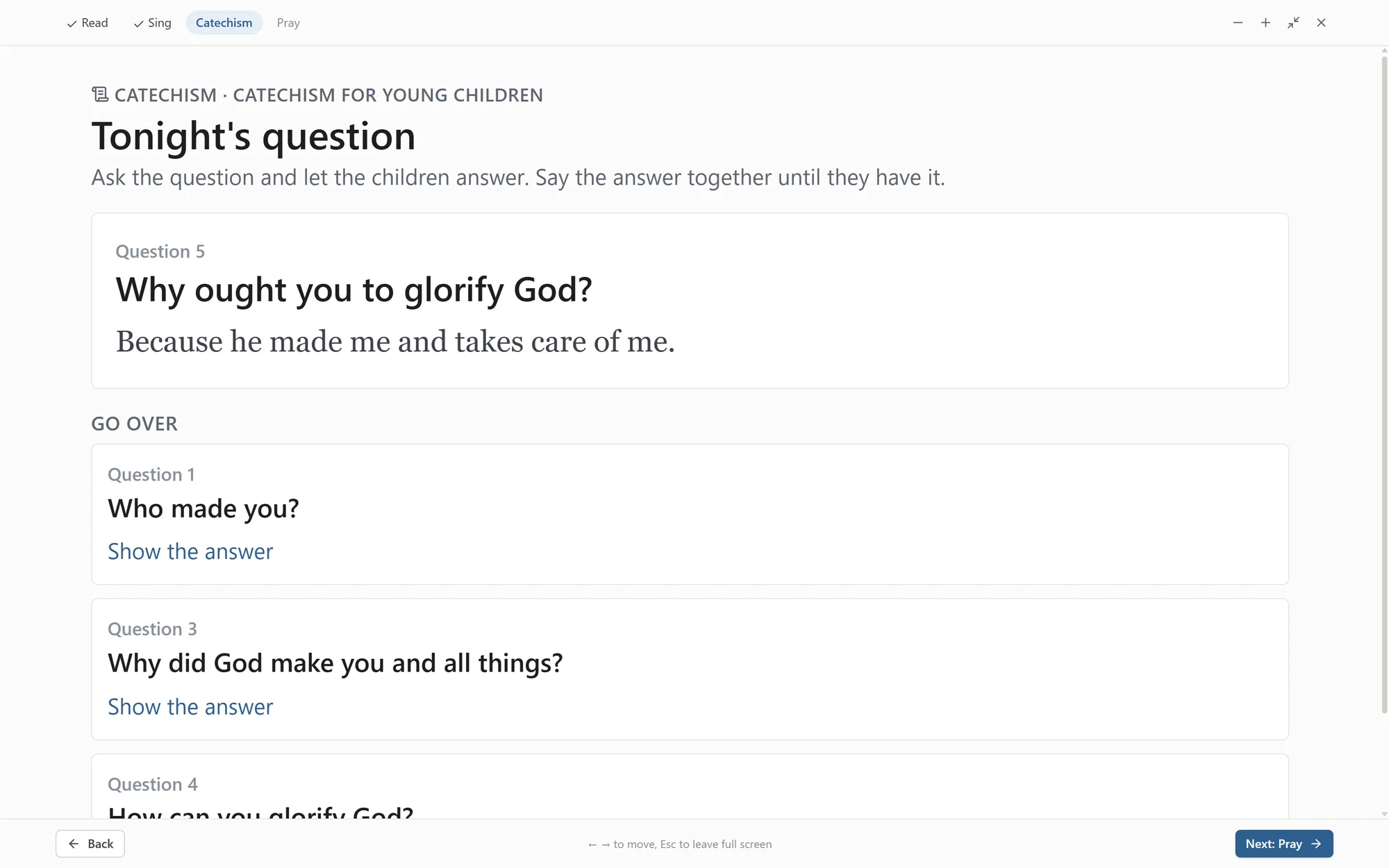
catechism question comes with its answer, to say together until the children have it. Earlier
questions come round again with the answer hidden until someone has had a try, so they are not
lost. At prayer time the page offers three names from your prayer
list, the three you have gone longest without praying for. The Lord’s Prayer is there
for the nights when words will not come.
The three questions for faith, love, and hope. Reword them, or add your own.
The Gather round button puts the same steps on the whole screen in large type, for the kitchen table or
the television. Press Amen at the end and the reading and the catechism move on to the next
place. The page counts the times you gather, not the days on the calendar, so a missed night
costs nothing. You pick up where you left off. There is no streak to break, only a quiet mark
for each day you met.
Gather round at the catechism. Tonight’s question, and the earlier ones coming round again with their answers hidden.
The Print this week button puts the next seven readings, the psalm, the catechism questions, the memory
verse, and the names to pray for on one sheet. For the one leading, the page gives a little
plain counsel and points you to the old helps. The Directory for Family-Worship, which the
Church of Scotland approved in 1647, is on the Confessions page beside the Catechism for Young
Children of 1840. James W. Alexander’s Thoughts on Family-Worship is on the Sojourner
Library shelf.
For Windows
Free Bible Software for Windows
If you are looking for a free Bible program for your Windows PC, Sojourner is one. It costs
nothing, it needs no account, and once it is installed it works with no internet connection at
all. It is a Bible study app for the desktop, not a phone app or a website.
Anyone who has used e-Sword or theWord will know the idea. The Bible sits in one pane and the
commentaries follow along in another. Sojourner differs in what comes in the box. Matthew Henry,
Calvin, the Westminster Standards, the Three Forms of Unity, the Psalter, and the Hebrew and Greek
with their lexicons are there when it opens, chosen for readers in the Reformed and Presbyterian
tradition. Nothing has to be hunted down and added one module at a time.
Logos and Accordance do far more, and they cost far more. Sojourner is not trying to be them. It
is for the pastor, the elder, the family, and the student who want Scripture and the best of the
old books close at hand without a bill.
What It Does Not Have
It runs on Windows only, and nothing syncs between computers. It does not update itself
either.
It cannot include the ESV, the NIV, or the NASB, because they are under copyright. The same is
true of BDAG and HALOT, the standard scholarly lexicons for Greek and Hebrew. If you own a
modern translation as a Zefania XML file, you can add it yourself.
Convictions
Offline, and Yours
Sojourner uses the network for exactly one thing. You press a button on the About page to
check whether a newer version exists. That is all. There is no account, no sync service,
and no telemetry of any kind. Nothing you read, search, write, or pray is reported anywhere,
because there is nowhere for it to go. Even the book shelves install from files you download
yourself, so they can just as well arrive on a USB stick.
Everything you write lives in one file on your machine. Snapshots and automatic backups run in
the background. You can export the whole database and import it again, run an integrity check,
keep a copy in a OneDrive or Dropbox folder if you want one, and look at your own reading
statistics on a heatmap. If the program ever crashes, the log stays on your computer.
This is not a marketing position. It is the only arrangement that makes sense for a book you
are supposed to read for the rest of your life. Companies fold and services shut down. A file
on your own disk does not.
Thy word is a lamp unto my feet, and a light unto my path.
Psalm 119:105 (KJV)
No program does that. But a good tool can keep you from setting the lamp down.
Where the Texts Came From
Every text in Sojourner is in the public domain or used under an open license. The About page
in Settings lists each source and its terms, with every Creative Commons credit the licenses ask
for.
The Hebrew and Greek texts, the lexicons, and the Factbook’s people and places come from
STEPBible and Tyndale House, and the parsing and lexicon data from OpenScriptures. The Berean
Standard Bible was given to the public domain by its makers in 2023, and the Literal Standard
Version and unfoldingWord’s two texts are used under their open licenses. The timeline
draws on the Theographic Bible Metadata, and the atlas on OpenBible.info, with coastlines from
Natural Earth. Most of the books on the shelves come from the Christian Classics Ethereal
Library. Others come from Project Gutenberg and from old scans kept at the Internet Archive.
Alexander on family worship was made for Sojourner by comparing six of those scans word by
word, and it has not yet been proofread line by line. The OpenDyslexic font, and the Ezra SIL font
that sets the Hebrew, are under the SIL Open Font License.
Webster’s dictionary of 1828 is in the public domain, and this edition of it comes from
DataWar’s under the MIT license. The Psalter’s words come from two public domain
editions kept at the Internet Archive, checked against the Free Church of Scotland’s text
and the printing of 1650. The dates of the church history on the timeline come from
Schaff’s History of the Christian Church and his Creeds of Christendom, the Nicene and
Post-Nicene Fathers, and the New Schaff-Herzog Encyclopedia.
The creeds and the Three Forms of Unity come from Philip Schaff’s Creeds of Christendom
of 1877. Schaff printed Dort’s Rejection of Errors only in Latin, so its English comes
from Thomas Scott’s translation of 1818. Calvin is the Calvin Translation
Society’s edition.
The 2020 harmony of the Gospels is the work of Robert M. Sutherland, copyright 2020, reproduced here with acknowledgment of his authorship as his terms ask. The 1922 harmony is A. T. Robertson’s and is public domain.
None of the Bibles, commentaries, confessions, books, or reference data in Sojourner was
written by AI. Where a source came with summaries written by AI, they were left out.
None of this is my work. It is the labour of Calvin, Henry, Spurgeon, Barnes, Orr, Easton,
Smith, Strong, Thayer, Brown, Driver, Briggs, Schaff, the Westminster divines, and the many people who
typed their books into machines and gave them away. Sojourner only puts them on one shelf.
Feedback
If something does not work, or a text is wrong, or you want the program to do a thing it does
not do, write to sojourner at gentleking.org. Bug reports are genuinely welcome
and corrections to the texts most of all.