The translations, the original texts, the lexicons, the commentaries and confessions, the four book shelves, and where every one of them came from.
What is inside
The Library It Ships With
All of this installs with the program. Nothing is held back, nothing unlocks later, and none
of it needs a connection to open.
Thirteen translations
Public domain or free to share
The eight older ones are the King James of 1769, the American Standard of 1901,
Young’s Literal, Darby, Webster’s, the Geneva of 1599, Douay-Rheims, and
Tyndale, which has the New Testament, the five books of Moses, and Jonah. The five modern
ones are free because their makers let them be shared. They are the
World English Bible, the Berean Standard Bible, the Literal Standard Version, and
unfoldingWord’s Literal and Simplified Texts.
The original texts
Hebrew, Greek, and Latin
The Hebrew Old Testament from the Leningrad Codex, the oldest complete copy of the Hebrew
Bible, read right to left. Five editions of the Greek New Testament. The Textus Receptus is
the Greek text behind the King James. The Byzantine text follows the great number of later
copies, and the Westcott and Hort, Tregelles, and SBL editions weigh the oldest copies most
heavily. Also the Septuagint, the ancient Greek translation of the Old Testament, and the
Latin Vulgate in its Clementine edition. All of them follow English chapter and verse
numbering, so they line up with the English beside them.
The six volumes of Matthew Henry’s Commentary on the Whole Bible, the forty-five
volumes of Calvin, Jamieson, Fausset and Brown, Barnes’ Notes on the New
Testament, and Spurgeon’s Treasury of David on all one hundred and fifty Psalms. The
footnotes Calvin’s translators added are marked as theirs and kept apart from his own
words.
The Westminster Standards
With proofs and a topic index
The Confession, the Larger Catechism, and the Shorter Catechism, each with its Scripture
proofs and a doctrinal index. Hodge and Shaw on the Confession and Vincent on the Shorter
Catechism sit right beside them. For the household there are also the Catechism for Young
Children of 1840, written to lead a child on to the Shorter, and the Church of
Scotland’s Directory for Family-Worship of 1647.
The wider confessions
The creeds and the Three Forms of Unity
The Apostles’, Nicene, Athanasian, and Chalcedonian creeds, the Belgic Confession,
the Heidelberg Catechism, and the Canons of Dort with their Rejection of Errors, all in old
public domain translations.
The Psalter
1650, with tunes you can play
The 1650 Scottish Metrical Psalter in full, all one hundred and sixty-three settings, on a
page of its own. Thirty-nine tunes play in the program, so you can hear the line before you
sing it.
Read aloud
A voice that runs on your machine
A neural voice ships with the program and reads any chapter, commentary, or book aloud with
no connection. It starts at the page you are on, or at any passage you select, and a list in
the player jumps ahead. Words light up as it reads, there is a sleep timer, and you can
correct how it says a name. A reference like John viii. 23 is read as John 8, verse 23.
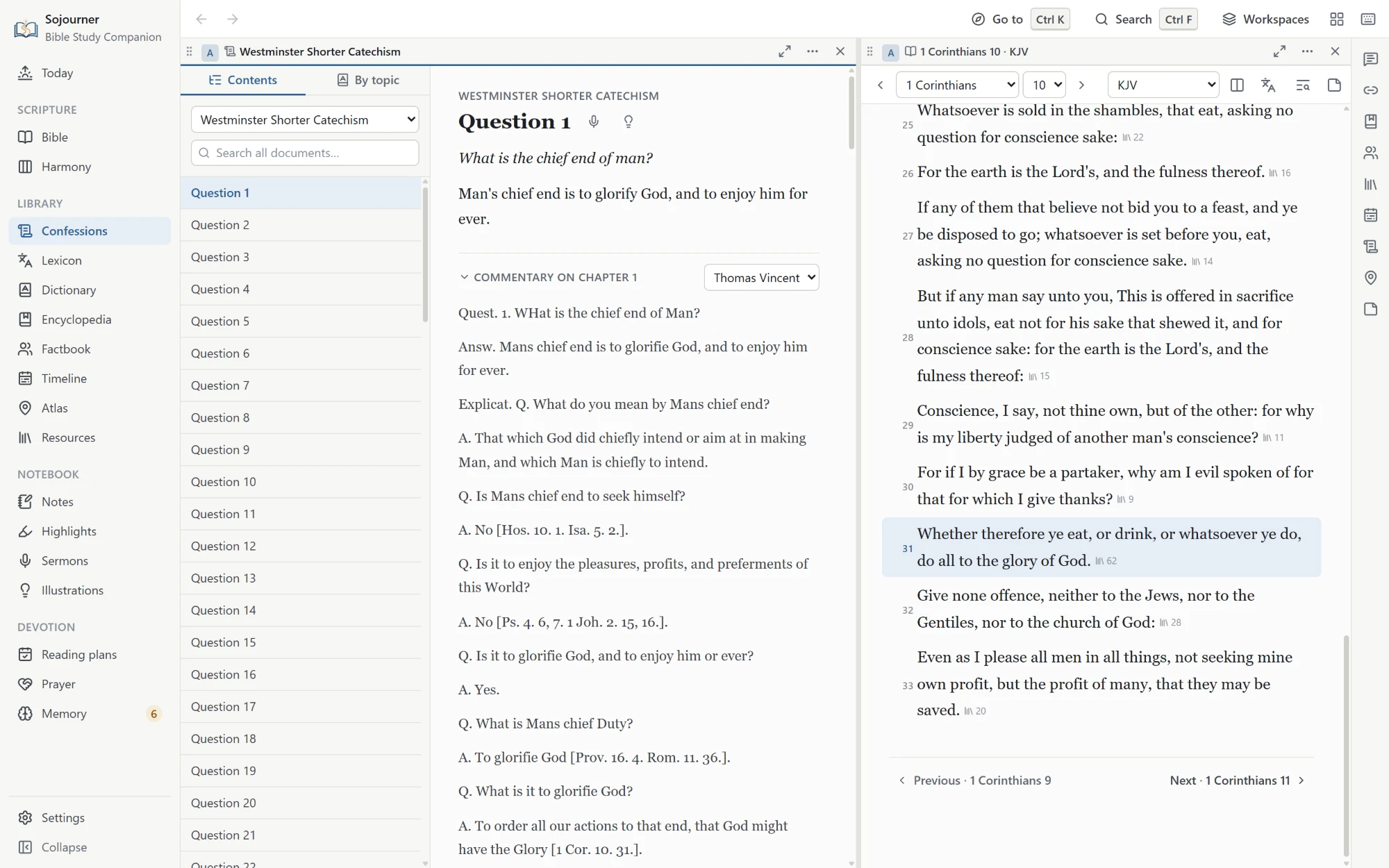
Opens the full size picture.The Shorter Catechism’s first question, with Thomas Vincent opening it up and 1 Corinthians 10:31, one of its proof texts, open beside it.
Reference
How Much Is in There
These are counts of very different things, so read them one at a time rather than against
each other.
9,349Encyclopedia articles, the International Standard Bible Encyclopedia of 1915
69,580Entries in Noah Webster’s American Dictionary of the English Language of 1828
5,998Dictionary entries, Easton’s and Smith’s merged by headword
344,757Cross references
4,275People, places, and things in the Factbook, each with its own page
1,342Atlas places, each with coordinates and every verse that names it
464Events on the timeline, from the Creation to Paul in Rome
296Events of church history, from the apostles to the present, each dated by its source
271Puritan and Reformed works on the Sojourner Library shelf
38Volumes of the Church Fathers on a shelf of their own
39Tunes for the 1650 Scottish Metrical Psalter, playable
14Atlas journeys, from Abraham to Paul’s voyage to Rome
6Reading plans, including M’Cheyne, a chronological year, and four weeks of family worship
2Harmonies of the Gospels in four columns, Sutherland’s of 2020 and Robertson’s of 1922
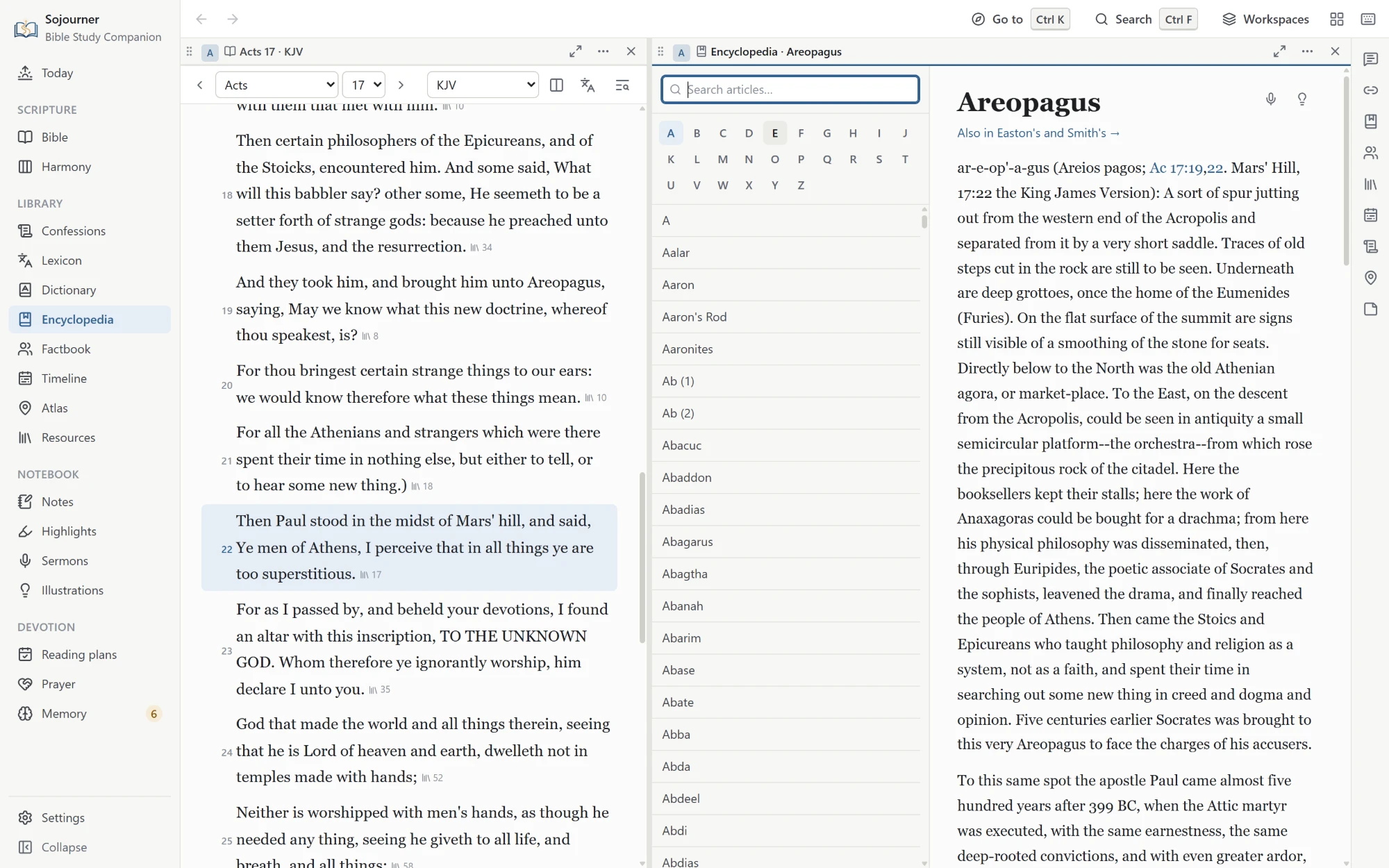
Opens the full size picture.Acts 17 beside the encyclopedia’s article on the Areopagus, the hill where Paul preached in Athens.
Webster’s 1828
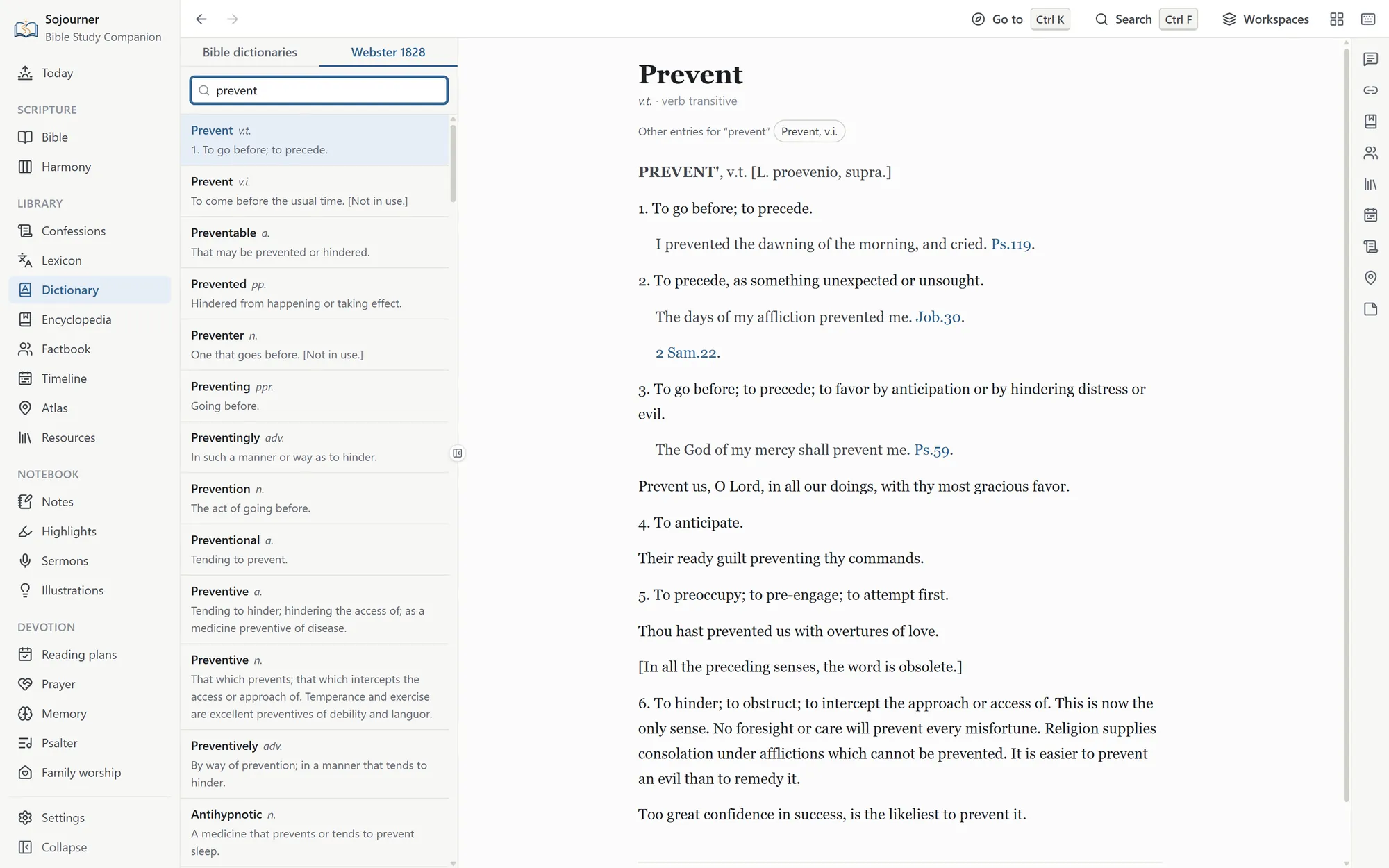
Many King James words meant something different four hundred years ago. Prevent
meant to go before, and conversation meant the whole way a man lived. Noah
Webster’s dictionary of 1828 still gives those older senses, and his Scripture citations
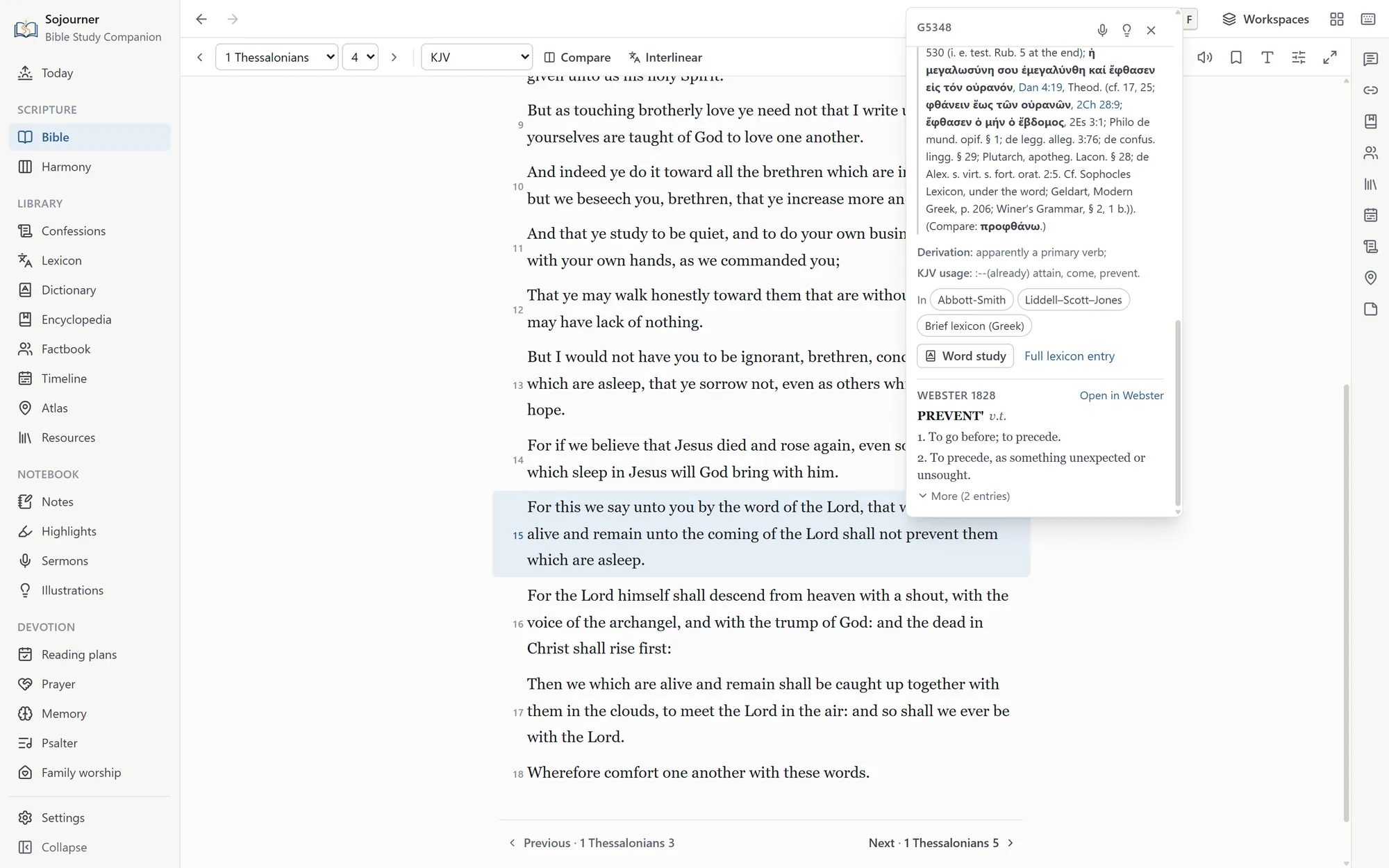
are linked. Double-click an English word and his entry is there beside the others, even for a
word as the King James spells it, such as letteth. The Dictionary page has a switch
between the Bible dictionaries and Webster.
Opens the full size picture.Prevent in Webster’s 1828. To go before, as in Psalm 119, I prevented the dawning of the morning.Opens the full size picture.1 Thessalonians 4:15. Double-click prevent and Webster is there beside the Greek, saying the word once meant to go before.
There is more on the shelves below. Once installed, their books are
read, searched, and linked exactly like the books you add yourself.
The book library
Four Shelves, and Your Own
The books come as four shelves, each a separate download on the releases page, so you take only
the ones you want and leave the rest. To install one, open Settings, choose Library packs, and
pick Install from file. Once a shelf is in, that button reads Install or update a shelf. Each
shelf can be removed there too.
The Sojourner Library
Two hundred and seventy-one Puritan and Reformed works.
The Church Fathers
The writers of the early church. The Ante-Nicene Fathers, from before the Council of Nicaea,
and both series of the Nicene and Post-Nicene Fathers, as Roberts, Donaldson, Schaff, and Wace
edited them, with Lightfoot’s Apostolic Fathers. Thirty-eight volumes in all.
Ancient literature
The writers around the Bible. Josephus and Philo, 1 Enoch, and three Roman writers,
Tacitus on the reign of Tiberius, the letters of Pliny the Younger, and Suetonius’s
Lives of the Twelve Caesars.
The nineteenth century
Schaff’s History of the Christian Church and his Creeds of Christendom, and
Edersheim’s Life and Times of Jesus the Messiah, with his books on the Temple and on
Jewish social life.
Inside the program, Resources sorts every book by shelf and by subject. Books of sermons,
theology, commentary, and the Christian life each sit together, and the Fathers are grouped by
series.
Cited in your library
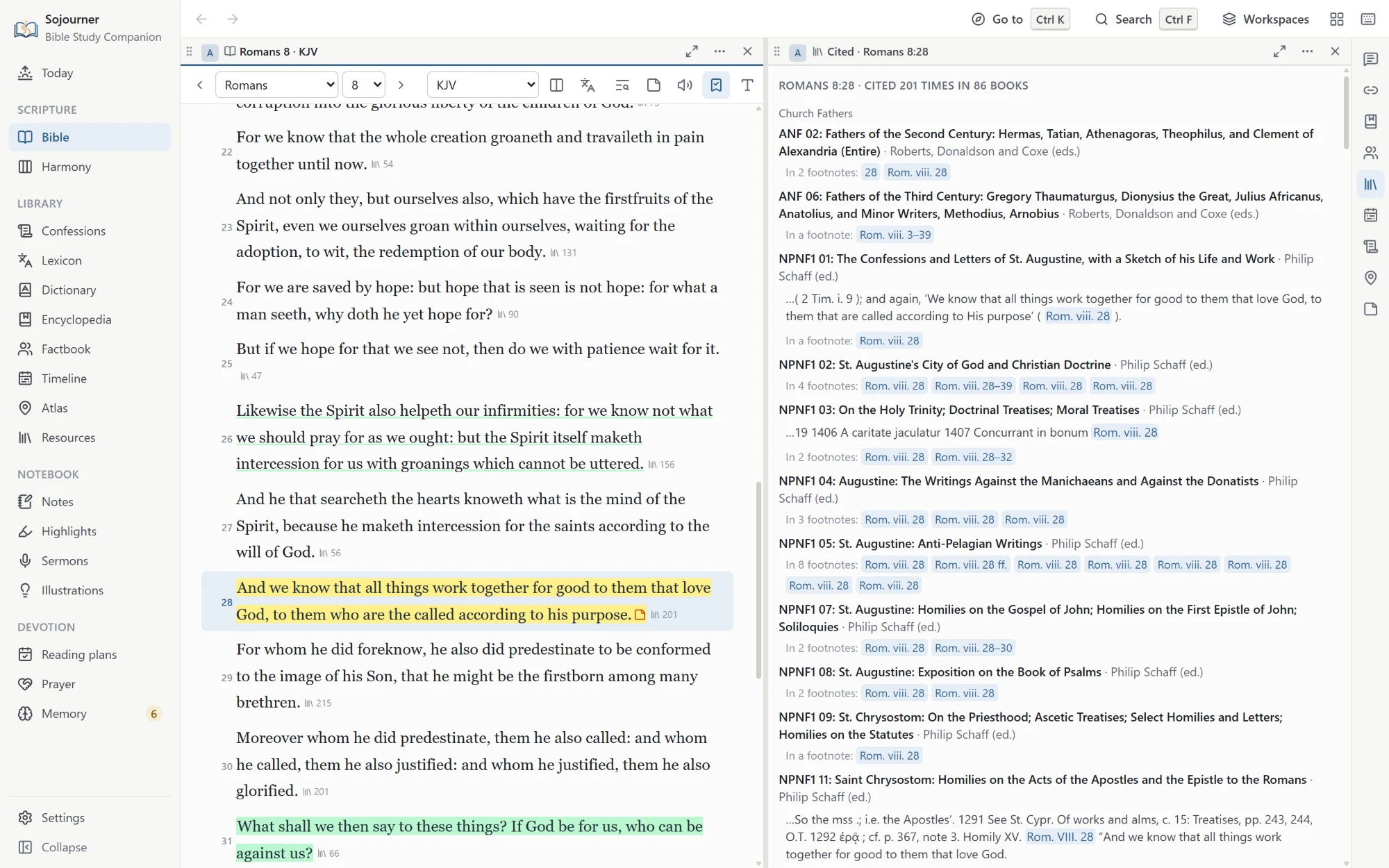
Beside each verse, a small count shows how many times the books on your shelves cite it. Click it for
the list, and click a citation to open the book at that page. It is a quiet way to find out who
else has stood over the verse you are reading.
Opens the full size picture.Romans 8:28, cited 201 times in 86 books. Each book shows where it cites the verse, and a click opens it there.
Your own books and recordings
Bring in your own EPUB, PDF, and MOBI books and your own audio and video. All of it goes into
the search box and is scanned for the verses it cites. You can group it by author, by date, or
by topic. Recordings play at the speed you choose, and a passage can link straight to the
moment in a recording where it is discussed.
Where the Texts Came From
Every text in Sojourner is in the public domain or used under an open license, save one harmony of the
Gospels, used by its author’s leave as set out below. The About page
in Settings lists each source and its terms, with every Creative Commons credit the licenses ask
for.
The Hebrew and Greek texts, the lexicons, and the Factbook’s people and places come from
STEPBible and Tyndale House, and the parsing and lexicon data from OpenScriptures. The Berean
Standard Bible was given to the public domain by its makers in 2023, and the Literal Standard
Version and unfoldingWord’s two texts are used under their open licenses. The timeline
draws on the Theographic Bible Metadata, and the atlas on OpenBible.info, with coastlines from
Natural Earth. The Terrain pack’s heights come from the Terrain Tiles on AWS, with SRTM and
GMTED2010 courtesy of the U.S. Geological Survey, ETOPO1 from the U.S. National Oceanic and
Atmospheric Administration, and EU-DEM produced using Copernicus data and information funded by
the European Union. The Imagery pack’s whole-world view is NASA’s Blue Marble Next
Generation, from the NASA Earth Observatory and in the public domain, and the rest of it contains
modified Copernicus Sentinel data 2024. Most of the books on the shelves come from the Christian Classics Ethereal
Library. Others come from Project Gutenberg and from old scans kept at the Internet Archive.
Alexander on family worship was made for Sojourner by comparing six of those scans word by
word, and it has not yet been proofread line by line. The OpenDyslexic font, and the Ezra SIL font
that sets the Hebrew, are under the SIL Open Font License.
Webster’s dictionary of 1828 is in the public domain, and this edition of it comes from
DataWar’s under the MIT license. The Psalter’s words come from two public domain
editions kept at the Internet Archive, checked against the Free Church of Scotland’s text
and the printing of 1650. The dates of the church history on the timeline come from
Schaff’s History of the Christian Church and his Creeds of Christendom, the Nicene and
Post-Nicene Fathers, and the New Schaff-Herzog Encyclopedia.
The creeds and the Three Forms of Unity come from Philip Schaff’s Creeds of Christendom
of 1877. Schaff printed Dort’s Rejection of Errors only in Latin, so its English comes
from Thomas Scott’s translation of 1818. Calvin is the Calvin Translation
Society’s edition.
The 2020 harmony of the Gospels is the work of Robert M. Sutherland, copyright 2020. His stated terms permit reproduction with attribution, so its order of events and their references are used here with acknowledgment of his authorship. His commentary, his Greek text, and the verse text he sets in parallel are not. The 1922 harmony is A. T. Robertson’s and is public domain.
None of the Bibles, commentaries, confessions, books, or reference data in Sojourner was
written by AI. Where a source came with summaries written by AI, they were left out.
None of this is my work. It is the labour of Calvin, Henry, Spurgeon, Barnes, Orr, Easton,
Smith, Strong, Thayer, Brown, Driver, Briggs, Schaff, the Westminster divines, and the many people who
typed their books into machines and gave them away. Sojourner only puts them on one shelf.
Free, on any device
Get Sojourner
Sojourner 0.4.1 is free. Open it in the browser on any phone, tablet, or computer, or
download it for Windows 10 and 11 or for Linux. It needs no account.